Building ecosystems in sports and esports
11/19/2025 - 14:59

- Uncover
This article was written for Uncover magazine - Meaningful Leisure Experiences.
3x3 basketball in the Netherlands
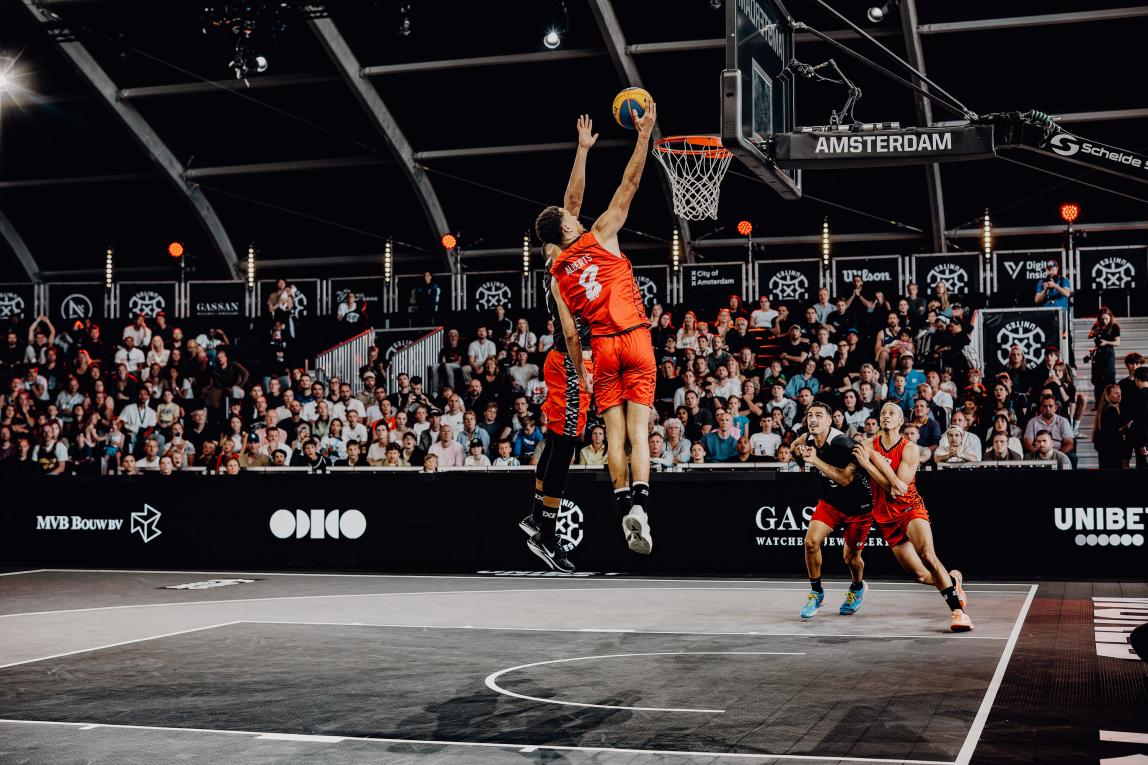
The moment that Worthy de Jong secured Olympic gold for the Netherlands at the 2024 Paris Olympics represented an unrivalled achievement in Dutch sporting history, and was watched far and wide.
In 5 vs 5 (traditional full-court) basketball, the Netherlands had struggled to compete with the top on the European and world stage and in 3x3 they reached the pinnacle, with the national women’s team getting gold at the 2023 FIBA (International basketball federation) Europe Cup and the men’s national team winning Olympic gold in Paris in 2024. What can other sports federations learn from the approach taken by 3x3 basketball in the Netherlands?
Long-term investment
Firstly, it did not happen overnight as it was the result of long-term investment. Just like the decisions we are taking now are shaping our future, the decision that the NBB (Dutch basketball federation) made to invest in 3x3 basketball in 2009 led to where it is today. In that sense, the Netherlands, along with France, are seen as front-runners and held up as examples internationally. The main reason for investment in 3x3 was to make basketball accessible to a wider audience. In 3x3, you do not need to be a member of a club or an association to be able to participate in the tournaments, which are organised by FIBA.
Visibility
3x3 tournaments take place on squares in neighbourhoods and at prime locations in cities. This opens people up to the sport and triggers their interest. “That’s why it is also very suited to expressing the lifestyle of basketball in addition to the sport. Music, clothing, sneakers, urban, everything can be found in the outdoors around 3x3 basketball,” explains Liam Brouwer (events officer and placement supervisor of a SES student at NBB).
Creating perspective on and off court
3x3 also recognises the power it has to make an impact, with the NBB working closely with 3x3 Unites, an organisation that looks to “… move, unite and empower youth to create perspective on and off the court” (Over 3x3 Unites, 2025). This collaboration aligns with the vision for 3x3 From the Streets to the World Stage and the NBB sees great potential in working together to develop 3x3 and the social impact it can have.
Diversity
3x3 basketball feels like it belongs to everyone, because it brings together various groups within the 3x3 community at recreational tournaments. There are several different levels and age groups across wheelchair basketball and standing basketball. The FIBA 3x3 Women’s Series is the world’s top competition for professional female 3x3 players and the FIBA 3x3 World Tour is the most prestigious event in men’s 3x3. Recognising the importance of gender equality in the sport, the 2024 Amsterdam World Tour event marked the first time that a 3x3 top tournament for men and women took place side by side. 3x3 showcases possibilities to organise tournaments in a different way from what we have traditionally seen and it has connected with a growing fan base in recent years.
Training programme
Although 3x3 originated as a street sport and amateur athletes do not need to be members of a club or federation, there are training and talent development programmes in place. The NBB provides hybrid training programmes that cater for 3x3 as well as 5 vs 5. The Dutch approach is proving fruitful, as seen in the growing professionalisation of 3x3 basketball and in the momentum it is gaining as a recreational sport.
The future is now; the approach of the NBB to step into 3x3 basketball has proven to be successful. Pioneering in an urban sport may lead to growth professionally and be worthwhile for society. This is in line with the approach taken in SES, which aims for an integrated approach to creating value for various stakeholders in the sports and esports communities and the ecosystems that they exist within. Let’s hope more associations follow this example where athletes can develop from the streets to the world stage, with benefits for society more widely incorporated in their design for advancing the sport.
Levelling up leisure: esports in Brabant and beyond
Esports has gone from living rooms to global stages, soon even the Olympic stage. The first Esports Olympics are set to take place in Saudi Arabia in 2027, formalising what many already see as a legitimate competitive domain. Yet, for all its growth at the elite level, the real opportunity lies at the grassroots. Building from the bottom up is essential to create inclusive, sustainable systems that help young people develop not just as players, but as people.
In Noord-Brabant, that philosophy is driving a growing esports movement. In cities like Breda and Eindhoven, the Level Up initiative is rethinking how young people engage with digital play. It is not about chasing sponsorships or turning every participant into a professional gamer. It is about creating environments where everyone, regardless of background or skill, can participate meaningfully, grow technically and socially, and connect with others through shared interests.
A system from the ground up
While esports often appears fragmented, shaped by commercial interests, publishers, and hype cycles, projects like Level Up provide something steadier: community, structure, and growth paths.
Participants in Level Up can play competitively at their own level, with support that goes beyond the game itself. The Brabantsport vision for Level Up-MDT is simple: ‘from player to achiever’.
They receive training in game strategy and production, but also in health, nutrition, and communication. These are transferable life skills, and applicable whether they go pro or not.
Here, too, a model is emerging in esports. Grassroots, who provide local tournaments, community events, and casual clubs. Developmental aspects, with coaching roles, content production, and small-scale team involvement. And professionals, high-level team play, international competitions, and career opportunities in media, marketing, and event management.
The goal is not just to move people ‘up the ladder’ but also to build a strong base, ensuring that the system is sustainable and beneficial at every level.
Esports as social space
In Peru, esports developed in LAN cafés - physical places where players gathered to compete and socialise. Gaming became a public, communal experience, not just a private online one. This helped create a uniquely social form of gaming culture, rooted in real-world interaction.
A local example of this is the Breda Guardians, a place for people that work, live, and study in Breda to come together as a community, play video games, and partake in local tournaments. Breda Guardians has partnered with Brabantsport in their new Level Up initiative, offering their facility, located at The HIVE at BUas as a training ground and home to foster these grassroots. The aim is to use gaming as a means to connect people, build confidence, and cultivate community, all of which strongly aligns with the Breda Guardians’ vision.
What does all of this mean for the future of leisure?
Esports has long outgrown the stereotype of isolated players staring at screens. Today, it is a platform for development - offering skills in leadership, strategy, storytelling, and collaboration. Projects like Level Up represent a shift in how we define leisure itself. Not passive consumption, but active participation. Not just entertainment, but education and empowerment. Whether at a keyboard in Breda or in a café in Lima, young people are shaping their futures, and their communities through play.
The SES specialisation has designed a programme that develops students from enjoyers of, to professionals, connecting students to the broader ecosystem that drives the continuous evolution of sports and esports.
Our special thanks go out to David Brouwer Muñoz (SES student) and Liam Brouwer (events officer and placement supervisor at NBB) for their contributions.