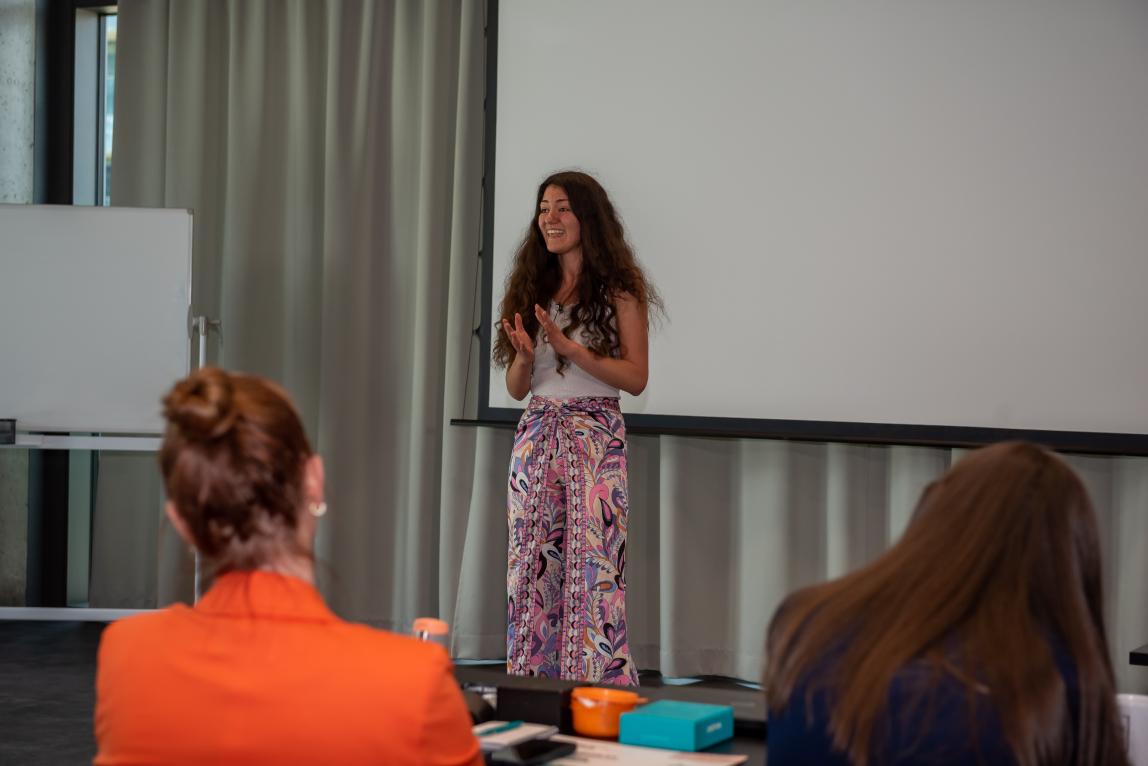
Interview with graduate Paulina Petrova
06/04/2026 - 10:38

- Stories
Today, Paulina is Chief Business Development Officer at a Bulgarian media company specialising in the distribution of radio and TV content rights for small and medium-sized operators. She has been there for eight years, steadily building her way up. And when she talks about the foundation beneath all of it, she keeps coming back to Breda.
A city that stays with you
Paulina spent her first year living in Hoeven, a village just outside the city, before settling more fully into Breda life. It left a mark that has never quite faded. Every year, usually in spring or summer, she finds her way back, drawn by the warmth of the city, its parks, and the community she built there.
‘I return every year,’ she says, ‘because I still want to feel and experience the vibe of the city.’ Nine years on from graduation, most of her former classmates now have houses and children of their own. She stays in touch with many of them online, and meets some in person during her visits. Life moves fast, but some bonds outlast the distance.
The coach who changed everything
Ask Paulina about her time at BUas, and one name comes up almost immediately: Rob Simons, her first-year mentor during the joint Leisure & Tourism programme that no longer exists in its original form. Back then, Paulina was modest, shaped in part by her stutter, which she had grown up with in a Bulgarian context where such things were not always met with understanding.
Low peer assessment marks and mounting self-doubt had begun to take their toll. Then, in December 2013, she sat down with Rob. His message was direct, but delivered with care: she had two choices, learn to stop letting her stutter dictate her life, or return home. ‘Those words really inspired me,’ she says. ‘I didn't have the chance to thank him back then, so I dearly hope these words reach him now.’
Later in her studies, Paulina was supported through her thesis by lecturer Olaf Ernst, whose patient guidance she remembers with equal warmth. ‘I am extremely grateful to him,’ she says simply.
Barcelona, Latvia, and learning by doing
In her third year, Paulina went to Barcelona for her placement, working at an event management company and discovering how the leisure industry operates within a completely different cultural rhythm. ‘The people are more oriented towards parties and the present moment,’ she says. It was an eye-opening contrast, and one that a classroom alone could never have provided.
For her graduation assignment, she headed to Latvia, working with a youth centre on their marketing strategy and game-based programming. Supervised by lecturer Olaf, she brought her graduation project back to Breda for her final exam and promptly froze. Knowing every word of her assignment was not the problem. The pressure triggered her stutter so severely that her examiners gave her ten to fifteen minutes to settle before continuing. She did. She passed. She graduated.
‘It was as scary as I would never, ever forget,’ she says, but what struck her most throughout her studies was something she had not expected: in the Netherlands, her stutter was simply not a thing. No special treatment, no mockery, no lowered expectations. Just the same standards and the same respect as everyone else. Coming from Bulgaria, where she had experienced the opposite, that meant everything.
Imagineering: the subject that never left her
Ask Paulina which subject from her degree she still draws on most, and the answer is immediate: Imagineering. A BUas signature course that explores the gap between a concept and its realisation, between 'what if' and 'what actually works', it gave her a framework she applies constantly in her work today.
‘It is really practical,’ she says. ‘You can use it right away.’ She has even tried to track down some of the books from the course to revisit the material, only to find they are no longer in print. It remains on her list of things to explore further, a quiet reminder that the best learning stays with you.
On AI, the human touch, and what the future needs
Paulina's current world sits at the intersection of media, business development, and a rapidly changing technological landscape. Her company uses AI to move faster and work more efficiently, but she is deliberate about where the limits lie. ‘I am still keeping the human aspect of the job as the most important thing,’ she says. ‘That is what distinguishes us from robots.’
As a member of a Bulgarian association for young leaders and entrepreneurs, she attends regular sessions on AI and its applications in business. She approaches it with curiosity rather than anxiety, and with a clear-eyed understanding that staying critical is the key skill of the coming decade. ‘I am trying to use AI as much as possible, but not to entirely depend on it. I depend on my knowledge and critical thinking.’
For the next generation Gen Z and Alpha, she sees both opportunity and risk. Young people are deeply connected online, and comfortable communicating through screens. But she believes that live experiences and human interaction are not optional extras; they are the point. ‘If we don't show them that real events and face-to-face connection matter, even though you can find everything online, the whole world is just going to move in the wrong direction.’
Paulina is already doing her part. One of her mentees, a young woman she has been guiding through early career decisions, is now considering studying Leisure & Events. Paulina did not hesitate: she recommended BUas immediately. ‘The programme made me confident. It gave me so much, that words fall short of describing everything it gave me.’
Her reasons for recommending the field itself are equally clear. The leisure and events sector, she argues, is not going anywhere. Unlike many industries facing disruption from automation, it depends fundamentally on human presence, human experience and human connection. ‘It is not going to disappear thanks to AI,’ she says. ‘That is exactly why it matters.’
What would Paulina need from BUas as an alumna?
As for what she would want from BUas as an alumna, beyond the obvious joy of staying connected, she has two specific wishes: access to the university's library resources, which she remembers as a genuine treasure, and the chance to reach students who stutter, or who carry similar invisible challenges. ‘It is not a stopper,’ she says firmly. ‘It is not a matter of intelligence. It is a matter of finding your confidence and I would love to help someone else find theirs.’