Not Back, but Forwards to Nature
08/25/2026 - 13:05

- Uncover
Authors: Peter Horsten and Simon de Wijs are the final editors of Uncover.
For the tenth anniversary edition of Uncover, its editors talked to Koert van Mensvoort. An excellent opportunity to zoom out on ‘mothership earth’ and zoom in on the value of Next Nature Museum, education and the impact of leisure as a sector.
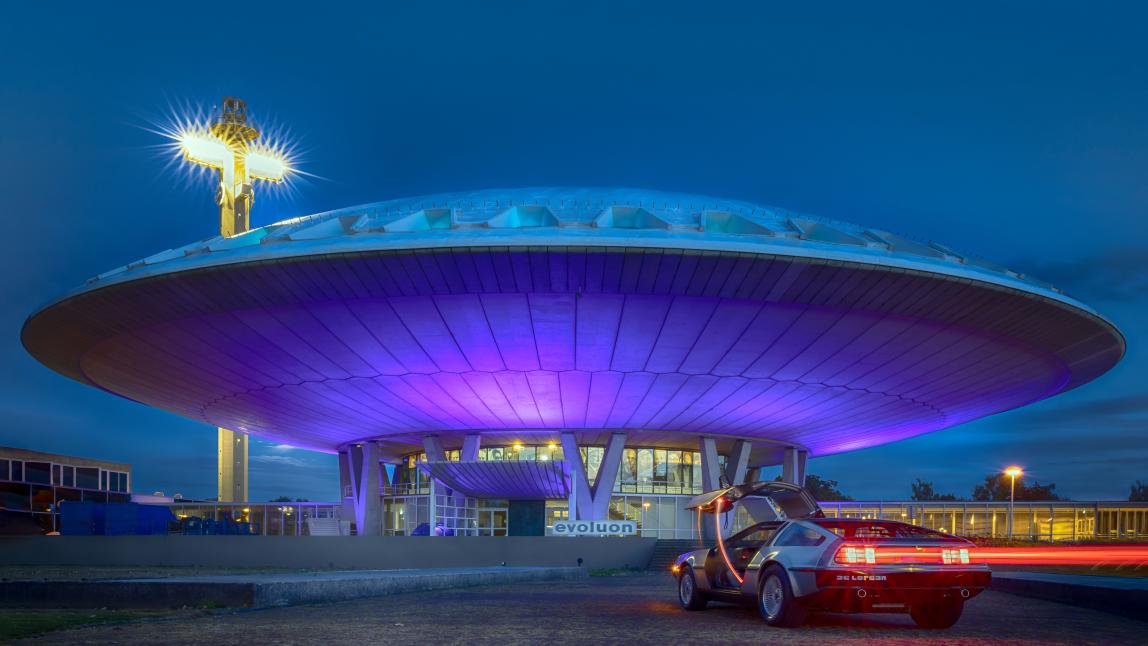
Van Mensvoort started his career as a video game developer and went on to study computer science, philosophy and fine art. He earned a PhD in Industrial Design from Eindhoven University of Technology and is the founder and director of Next Nature, a 21st-century nature organisation that aims to move forwards – not back – to nature. In 2022, he reopened the iconic Evoluon in Eindhoven as Next Nature Museum.
His projects are as varied as they are bold. From the travelling NANO Supermarket to the Data Fontain. He has also published several books, including The In Vitro Meat Cookbook and Pyramid of Technology. His work explores how people and technology evolve together, in search of a future that is good for both people and planet.
How have the different paths you have taken shaped you? And can you identify a turning point when you began to focus more on developing a vision of where we are heading as a society?
As a teenager I wanted to express myself and that found a place in making video games. With both parents working at Philips and a father who was an engineer, the move to computer science was an easy one. But I realised I also wanted to give the visual side some space. When I found out that you could study multiple courses for the price of a single tuition fee, I simply enrolled at art school and also studied philosophy for a while. That was a very defining step for I ended up in two completely different worlds: computer science students who are very technically and operationally minded, and art school students who either did not want to engage with the world, or wanted to create a different world. Both were creative, but in very different ways. Art school allowed me to infuse the dry, abstract thinking of computer science with imagination and design.
Then I went to the Sandberg Instituut, which had an unconventional approach where the lecturers would ask straight away: “How are you going to change the world?” and tell me: “You’re going to get a 10 or a 1, and we’re not going to discuss anything in between.” Around 2004, a light really went on. I discovered that it is wrong to view nature and technology as opposites. That idea took root in my mind, and I had the freedom to simply spend time on it. I would recommend that kind of space to everyone, because success is never the goal, but always a side effect of genuine fascination and in-depth understanding. By giving a delicate little flower attention and nurturing it, it will grow.
Can you give some examples that clarify why the distinction between nature and technology is actually an illogical one?
People often think that technology is futuristic but in fact, it is deeply rooted in our past. Take agriculture, for example: ten thousand years ago, it was the great innovation. People stopped hunting and travelling, began growing crops and domesticating animals, and from then on lived in villages that grew into cities. Without that invention, eight billion people simply could not survive. In short, we have become an agricultural species.
Another example: bees collect nectar from flowers, but at the same time help spread the flowers dispersing pollen. On the large scale of evolution, this is co-evolution: two species that have shaped one another. Today we naturally refer to this as ‘nature’, but it is essentially an intimate intertwining between two organisms that need each other, and I believe the relationship between humans and technology should be understood in exactly the same way.
From the very beginning onwards, we have been fundamentally intertwined with technology. Take cooking food, for example; something no other animal does. That invention provided more calories in less time, and literally helped shape who we are today, with a smaller digestive tract and a larger brain.
Moreover, some technological systems even take on a natural dynamic of their own. We created the financial system, but it has taken on a life of its own. And studies show that the growth of cities bears a striking resemblance to the spread of microorganisms.
In short, humans are, by nature, technological beings, just like a bird that builds a nest or a beaver that constructs a dam. But we take it much further than that. Scientists have calculated that the total mass of everything created by humans – the technosphere – now outweighs all biological life on earth combined.
How can we prevent ‘forwards to nature’ from becoming just as romanticised and hollow a concept as ‘back to nature’? Scientists often express reservations with regard to the technosphere. Where do you draw the line between a dream future and a nightmare?
The biblical narrative is deeply entrenched into our culture: nature as a paradise, which humans have done nothing but spoil ever since. But it is a persistent misconception that nature used to be better. If you seriously think about how our grandparents lived, you certainly would not want to go back.
Yet, I believe it is our duty to find a sense of optimism. It takes no effort at all to see how everything is going wrong; the newspapers are full of it. But it takes a great deal of imagination to picture a world that is desirable, that you would wish for others, and that is achievable. In seeking out what is possible, every generation plays with fire, embracing new opportunities whilst also facing new risks and responsibilities. Techno optimism must be balanced and not be naive: there is a real risk in forward thinking that simply kicks today’s problems into the future. You must always set out what the desired future looks like and, through a disciplined approach, give tangible substance to how to get there.
It is often a private dream that is actually a public nightmare. Big tech billionaires who put their own interests first, whilst trampling on everyone else. In effect, it’s a feudal system. When it comes to techno-privilege, questions of access are essential, and public ownership is, for me, a fundamental principle. Consider also ‘enshittification’: platforms that people join because they are convenient, but as soon as they become dependent on them, they are squeezed dry. As McLuhan said: ‘The medium is the message’, and you often only realise that once you’re right in the thick of it: ‘The fish didn’t know it’s wet.’
Can you give specific examples of when technology and nature strengthen each other?
For me, cultured meat sat right at the intersection of the manufactured and the grown. When I joined a group of TU students to discuss this topic, I literally said to them: the number of people working on cultured meat worldwide has now doubled, from three to six. Ten years ago, I was still being laughed at on the children’s television show ‘Klokhuis’. But what seems strange today may be the norm tomorrow. Hunting used to be the norm; now it is called ‘game’. In a hundred years’ time, cultured meat might be the norm and slaughtered meat might be called ‘game’. The crux of the matter is serious: a protein transition is needed. If the whole world ate as much meat as we do, you would need three planets.
Another story is that of the artificial womb. Following a lecture for gynaecologists, we are collaborating on this development. At Next Nature, we are adding a social dimension, because as soon as the technology is available, fundamental questions arise. Is this the ultimate feminist project? Or are male engineers taking away something essential from motherhood? We see ourselves as facilitators of that conversation. Putting perspectives on the table before you end up wandering off in it whilst sleepwalking.
Finally, the energy belt from the Nano Supermarket: the idea that you can charge your smartphone using your own belly fat. With just one kilo of body fat, you can charge your phone for a whole year. The molecular mechanism is simply established science. I think it makes perfect sense that, within this century, people will link their electronic devices to their own metabolism. And that immediately raises questions about equality: when some people can upgrade themselves and others cannot, the distinction between the haves and the have-nots is far more fundamental than the choice between an iPhone or an Android. Let’s start that conversation now.
Could you outline the essence of Next Nature Museum as a physical location?
What I see here is a spaceship, a UFO that has somehow landed here. It is a tremendous honour to be the director of such a magnificent building, but also of a UFO. In a sense, that makes me a representative of extraterrestrial life on earth.
And why has that UFO landed here? Ultimately, earth is our mothership. ‘There are no passengers on Spaceship Earth, there is only crew.’ We are all crew. A narrative championed by astronauts and thinkers such as McLuhan and Fuller.
This UFO has docked here to help us become a better crew, working together towards a harmonious future for all life on Earth. I want to turn this into a museum of the future, a place where this conversation takes place and where everyone is welcome. Whether you’re an eleven-year-old child or a forty-year-old engineer at ASML: if you see a spaceship, you’ll want to go inside it. We need to capitalise on that feeling to appeal to everyone.
We live in an era of social media, podcasts and online dissemination – why does the Next Nature philosophy need a physical museum?
In 2019, we organised a major exhibition in Shenzhen that attracted forty thousand visitors, whilst all sorts of things were happening in Tokyo, Dubai and Brussels at the same time. At one point, we looked at each other and thought: wouldn’t it be lovely to have one central place where we could bring everything together? And that is what this has become.
It really could not be better, not least because this building was originally constructed by Philips with a clear mission: to tell the story of how people use knowledge and technology to transform their environment. That is, in fact, a Next Nature story too. It was a perfect fit.
At the same time, I must be honest: we are currently so deeply involved with this place that, as a team, we have less time for other projects. My hope is that this museum will serve as a forum for discussing the region’s future, but also act as a beacon from which that story can be shared with the wider world.
The museum is organised around four themes. Could you explain the journey that visitors ideally undertake, from a cosmic perspective to a sense of personal urgency?
I wrote this down five years ago and we are still working on it. But the direction is very clear.
As soon as you enter, you are immediately asked: what sort of crew member could you become? You answer a few questions, and based on your answers, AI creates a personalised journey for you. Certain exhibits are highlighted as particularly important for you, you are given training tasks, and you earn badges. In this way, you build up your own crew member profile step by step. The journey may be different for everyone, but the overarching story applies to everyone.
The journey begins with the geosphere: how did it all begin? There is a ring you can turn to take a ten-minute journey to the earth’s core and back again. Next comes the biosphere: how did life originate? As far as we know, earth is the only place in the universe where there is life – and that is what makes it so special. Then the technosphere: the transformative impact of technology on the planet, right now. We humans are the link between the biosphere and the technosphere. We originate from nature, yet at the same time we are the ones who set the technosphere in motion – a crazy jungle which we ourselves no longer always have control over. At the very top is the mindsphere: what does technology mean for your life? That is where the Digital Wellness Centre is already situated. By actively participating in this visitor journey, you move from a cosmic perspective to a sense of personal urgency. And then, as a certified crew member, you naturally return to the world.
Thinking in terms of crew roles and responsibilities can be overwhelming. How do you ensure that the museum experience remains manageable?
You have to break it down into small steps. People can feel overwhelmed by the scale of what is at stake and feel insignificant. But you are also connected. If you make that connection tangible, the focus shifts from the scale of the problem to what you can do right now in your own life – and that can be something small. At the same time, I want to encourage people to think on a planetary scale. That is not easy, because we evolved on the savannah, with priorities such as food and tribal conflict. You see that reflected in geopolitics today through the most advanced means, such as AI and weapons. That is precisely why I want to keep it light: when I get up today, what can I do?
Young people are the future, but they would rather spend all their time staring at a screen. How do you try to reach that generation with a real-life experience, and does steering clear of smartphones really fit with the idea of ‘forwards to nature’?
It starts with getting to know the child within yourself. We get a lot of young people coming in here. During a session with astronauts, I was blown away by the energy that 10-year-olds radiate. I don’t see it as lecturing, but rather as laying a few foundations, with a focus on experience. And children can teach us a great deal too.
We do indeed make very limited use of screens in the museum. The spaces are real experiences. That is not a rejection of technology; it is always a double-edged sword. What matters to us is exploring a better relationship with technology and awareness. Take the swipe wall in the Digital Wellness Centre: inviting children to swipe with their whole bodies and make large movements that are better suited to our physical nature. The fact that an entire generation has become so engrossed in their smartphones has victimised some of them. But I hope that in thirty years’ time we will be able to laugh about how an entire generation spent the whole day staring at a small screen as if it were some kind of religious object.
Social media turned out to have an addictive mechanism built into it. Do you see a role for the government here? What is needed?
First of all, better design. Many platforms are designed to draw attention and sell advertisements. A more human-centred design appeals to people’s senses and needs – with people as the end goal, not the means to an end. Because as things stand, you are not even a user anymore. You are a sensor. A reactor.
Those companies are not going to change that of their own accord, so legislation is important. Europe is taking the lead in this regard, not by banning everything, but by setting out frameworks. Those big tech companies are superorganisms that have become so dominant they can take on governments. That is why culture is also essential: norms and values. If all the incentives are designed to push you in a certain direction, you are defenceless as an individual.
Better design, legislation and culture. Those three combined.
How should the education system reinvent itself, and how can it avoid training people for jobs that will soon no longer exist? Which skills deserve to be given greater priority on a structural basis?
The model where the teacher simply crams knowledge into students’ heads is a thing of the past. The teacher is increasingly becoming a coach who helps pupils navigate the jungle of information. I am a strong advocate of competence-based, Montessori-style education, in which the student takes the lead in their own learning process.
And there are other skills that are becoming more important. Soon, a waiter will earn more than a lawyer, and a good nurse more than a surgeon. Lawyers and accountants are trained to handle large amounts of linguistic knowledge. A computer can do that too. Professions where human interaction is key and where you work with your hands are, in fact, becoming more important. The three key concepts: hospitality, empathy and human tact.
Then there is creativity, which by definition is something you cannot automate. To encourage creativity, I use the thumbtack model: a point and a broad head. You really excel in one particular area (depth), whilst at the same time being able to make connections with all sorts of other domains (breadth).
In the past, people were trained to do the work that computers and robots do. Now, those machines are getting better and better at doing it themselves. So let’s get good at what makes us human: empathy, communication, connection, creativity.
How do you balance honesty about pressing challenges with keeping hope alive and leaving room for discovery?
For that purpose, I use the concept of ikigai: ‘reason of being’. Four questions: are you doing what you love? Are you making a difference to others? Are you good at it? And are you earning a living from it?
That balance varies greatly among young people. Some say: “I just have to get rich,” but do they actually contribute anything? Others want to save the planet from climate change, but can they make a living? Neither of these is ikigai. It’s about balancing all four facets. And the wonderful thing about a good ikigai is that you no longer have to look up to billionaires like Jeff Bezos. If you can give something to a hundred people or make them happy, that actually has more value.
And if we zoom in on our field of expertise of leisure and live experiences, is a new vision needed? Because, on the one hand, ikigai perfectly illustrates what leisure can be: people in a happy place, making a contribution, relaxing. On the other hand, you also see the extreme side where everything has to be a great spectacle.
The concept of ‘leisure’ was invented as a counterpart to work during the Industrial Revolution: a time to recover, so you could then go back to work. But that distinction has not always existed and is artificial. On the savannah, work and leisure were completely intertwined.
If I may dream, let’s do away with that distinction again. Let’s ensure that work and leisure go hand in hand, because your work is your passion. It reminds me of those holidays where people go to a farm in France to spend a week weeding. And then actually pay for it. Recently, a property owner who does not need to work for financial reasons said to me: “I don’t meet any interesting people anymore, so I’d rather just get on with my work.” This also highlights the importance of friction and urgency in life.
In that sense, for me it is not about ‘going back to nature’ either; Next Nature is about transformation. It is about how an intuition from the past resurfaces in a new way within an innovative framework. The essence we are looking for is enthusiasm: this is what I am working on, and this is what I want. That also requires self-awareness: who am I, and what can I contribute?
Joseph Pine talks about the transformation economy and ‘human flourishing’. Isn’t this also about a shared responsibility to create an environment in which we can flourish, and where growth is not the only driving force?
Absolutely; if the individual parts are doing well, the whole will do well too. If you and your surroundings are doing well, you do not just have flourishing – you have fractal flourishing.
Nature follows a cycle: a flower blooms and withers, becoming compost and nourishment for a new season. Everyone knows that at some point a recession will come, a reset, and then the next cycle begins. The mission is to bring the technosphere into balance with the biosphere. That love story is the underlying mission everywhere.
I like the garden metaphor: a good gardener looks not only at the individual plant, but at the orchestration of the whole. That gardener’s mindset combines intervention with letting go. If we all become better gardeners, whether it is your vegetable garden, the city, or the planet, then it could still turn out to be quite a beautiful world.
Photography:
Jip Barth
Next Nature
Nichon Glerum