Qatar Museums Authority and the National Museum of Qatar

Qatar Museums Authority and the National Museum of Qatar

08/25/2026 - 13:23

Museums are increasingly stepping beyond their traditional role as guardians of heritage to become platforms for addressing contemporary societal challenges such as sustainability, cultural identity and community engagement. In Qatar, this shift is reflected in the work of Qatar Museums Authority, which has positioned culture as a driver of innovation, education, and international dialogue. A prominent example is the National Museum of Qatar (NMoQ), a project that combines heritage preservation, architectural innovation and cultural storytelling.
Leisure & Events
  • Uncover

This article was written for Uncover magazine – From Global to Ground (10th edition). You can read the full magazine here. 

Authors: Dr Fatema Al Sulaiti is Director of International Cooperation & Government Affairs at Qatar Museums Authority. Dr Mireia Iglesias is Head of Events, Programs and Communication at the World Leisure Organization.

Over the past two decades, Qatar has placed culture and heritage at the heart of its national development strategy. Through institutions such as Qatar Museums Authority, the country has invested heavily in cultural infrastructure, heritage conservation and international cultural cooperation. These efforts form part of broader strategies to diversify the economy beyond hydrocarbons while strengthening national identity and global engagement.

Qatar National Vision 2030
This cultural agenda is closely aligned with Qatar National Vision 2030, which promotes sustainable development across social, economic, environmental and cultural dimensions. Within this framework, museums and heritage sites are increasingly recognised as spaces that support education, tourism and community participation. They also serve as platforms for international exchange, connecting with global cultural networks and initiatives, including those led by UNESCO and international museum partnerships.

In this evolving context, heritage is being approached not simply as a legacy of the past, but as a resource for shaping the future. Cultural initiatives increasingly connect heritage preservation with innovation and sustainability, using cultural spaces to foster environmental awareness, youth engagement, and intercultural exchange. Across the region, such initiatives are positioning museums and heritage sites as catalysts for urban regeneration, cultural diplomacy and social transformation.

Heritage-led regeneration at the National Museum of Qatar
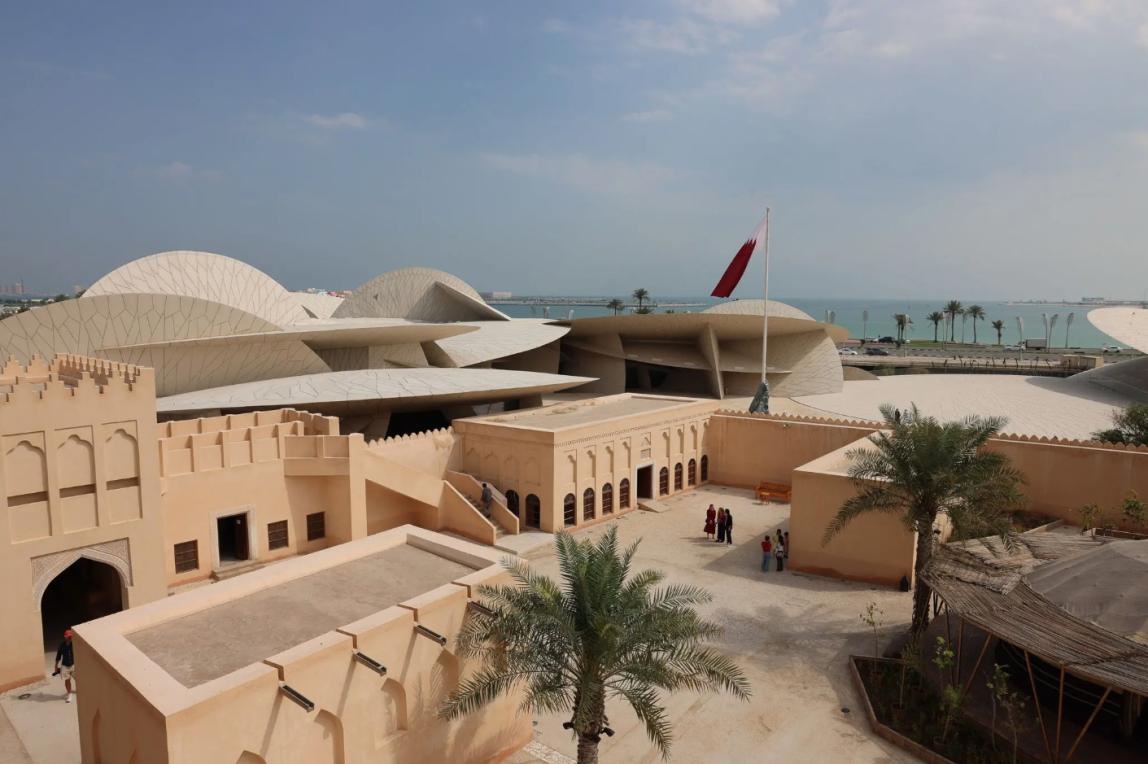
One of the most striking examples of this approach is the National Museum of Qatar, which integrates the historic Old Palace of Sheikh Abdullah bin Jassim Al Thani within a new museum complex designed by architect Jean Nouvel.

The Old Palace, built in the early 20th century, once served as the residence and seat of governance of Qatar’s ruler. In 1975 it became the country’s first national museum, marking an important step in the preservation of Qatar’s cultural heritage. In the redevelopment of the National Museum, the historic palace was carefully restored and placed at the centre of the new architectural structure.

Rather than replacing the historic building, the project embraced adaptive re-use, allowing the past and present to coexist within a single cultural space. The palace now forms the symbolic and physical core of the museum, surrounded by Nouvel’s contemporary structure inspired by the natural formations of the desert rose.

This approach illustrates how heritage-led regeneration can integrate conservation, contemporary architecture and cultural storytelling. The museum’s exhibitions guide visitors through Qatar’s environmental history, cultural traditions, and rapid social transformation, creating an immersive narrative that links past and present.

Connecting to societal goals
Beyond architecture, the museum plays an important role in broader societal goals. Through exhibitions, educational programmes and public initiatives, it promotes cultural awareness, encourages intercultural dialogue, and engages both local communities and international audiences. The project also contributes to sustainable cultural tourism and knowledge exchange, reinforcing the role of museums as spaces of learning and dialogue.

In this way, the National Museum of Qatar demonstrates how heritage institutions can contribute to sustainable cultural ecosystems, aligning with global agendas such as the United Nations Sustainable Development Goals, particularly those related to sustainable cities, heritage protection, and education.

Projects such as the National Museum of Qatar highlight the growing connection between culture, heritage and leisure experiences. Museums and heritage sites are increasingly recognised as spaces where learning, recreation and social interaction converge.

This perspective aligns with the broader mission of the World Leisure Organization (WLO), which promotes the role of leisure in enhancing quality of life and supporting sustainable development. Cultural initiatives in Qatar illustrate how heritage and leisure can work together to foster dialogue, creativity and more sustainable societies.