Hidden in Plain Sight: Jewish Cultural Heritage, Sustainable Tourism, and the Diversity of European Memory
09/03/2026 - 11:48

- Uncover
This article was written for Uncover magazine – From Global to Ground (10th edition). You can read the full magazine here.
Author: Licia Calvi is a senior lecturer and researcher at Breda University of Applied Sciences. She specialises in digital storytelling and heritage studies.
JEWELS TOUR
Jewish Cultural Heritage in Europe sits at a particularly charged intersection of this debate. It is an integral part of our European shared history and yet, it is one of its most endangered legacies: the tangible Jewish heritage - synagogues, cemeteries, former ghetto quarters - is under material threat across the continent, while its intangible counterpart, spanning over the practices, memories, oral traditions, and living cultural expressions of Jewish communities, remains largely invisible in mainstream tourism and heritage narratives. JEWELS TOUR (JEWish hEritage as Leverage for Sustainable TOURism) is a European project which addresses both dimensions, offering compelling case studies and inspiring good practices in what sustainable, community-centred heritage valorisation can look like in practice. Funded by Interreg Europe, the project brings together public authorities and local organisations from six European cities with a documented Jewish presence: Coimbra (Portugal), Erfurt (Germany), Ferrara (Italy), Lviv (Ukraine), Lublin (Poland), and Riga (Latvia). BUas has joined it as an advisory partner since its launch in 2024 with an interdisciplinary team.
What sustainability really means for heritage tourism
The word sustainable has been used so broadly in tourism discourse that it risks becoming an empty concept. In the context of JEWELS TOUR, whose full title foregrounds the term, sustainability carries a multi-layered meaning. Sustainable valorisation, as the project defines it, must generate cultural and social benefits alongside economic ones. It must be transferable: producing models and practices that can outlast project funding. And it must be equitable: ensuring that the communities whose heritage is being valorised have genuine agency in shaping the narratives presented to the world.
This last dimension is perhaps the most demanding one. Research has consistently shown that heritage professionals, however well-intentioned, can become what Diego Rinallo (2020) calls ‘gatekeepers’ - experts whose assessments inadvertently legitimise certain stories and communities while marginalising others. JEWELS TOUR responds to this risk by insisting on broad, cross-sectoral stakeholder engagement that extends well beyond the local Jewish community, tourism offices, and heritage managers to include the wider non-Jewish population, diaspora communities, and individuals reconnecting to their roots and family origins.
Sustainability, in this sense, is not only ecological or economic - it is also narrative: ensuring that the stories told about Jewish heritage are inclusive, contested where necessary, and capable of resonating across generations and places.
Six cities, six ecosystems
One of the most instructive aspects of JEWELS TOUR is precisely the diversity it holds together. The six participating cities span the continent geographically and politically, range widely in the size and visibility of their historical Jewish communities, and face very different challenges in making that heritage visible and accessible. Yet, across this diversity, shared themes emerge, and the tension between the local and the common is itself one of the project's most generative dynamics.
All six cities are experiencing growth in tourism, including international visitors, which sharpens the need for a heritage offer that is both attractive and accessible to diverse audiences. For some cities, Ferrara and Riga among them, this growth in visitors runs paradoxically alongside a decline in resident population, making the question of whose heritage is being valorised, and for whom, all the more pressing.
Coimbra
Coimbra's Jewish history reaches back at least to the ninth century, making it one of the oldest documented Jewish presences in Portugal. The discovery in 2013 of a Jewish ritual purification bath - a Mikveh - at the edge of the old Jewish quarter, the Judiaria, originally located on the outskirts of the walled city, has opened up new possibilities for both scholarly research and heritage tourism.
Coimbra's participation in the project has centred on the development of competitive place-based tourism products rooting the visitor experience in the specific texture of the city's Jewish history, like the creation of a dedicated touristic product around the recently discovered Mikveh. These products should diversify, qualify, and consolidate Jewish tourism at a moment when interest in Jewish history across the Iberian Peninsula has grown significantly following broader recognition of Sephardic heritage across Portugal and Spain. Storytelling is seen as the key element here. The municipality aims at the development of an ad hoc storytelling-driven training programme for guides and tourism agents.
Erfurt
Erfurt brings to the project an exceptional asset: its medieval Jewish heritage was inscribed on the UNESCO World Heritage List in 2023. The Old Synagogue, dating from around 1100, is one of the oldest, best-preserved and the largest surviving testimonies of Jewish presence north of the Alps.
The city's priorities within JEWELS TOUR focus on uplifting the overall visitor experience and improving the visibility of the territory by developing digital tools and adopting diversified approaches to promoting Jewish heritage. This points to a recognisable challenge: having a prestigious heritage asset does not automatically translate into a rich, layered tourism offer, even if visitor numbers have continued to rise since UNESCO inscription. But the deeper stories - the living practices, the post-war community, the contemporary Jewish presence in Erfurt - risk being overshadowed by the medieval monument.
Ferrara
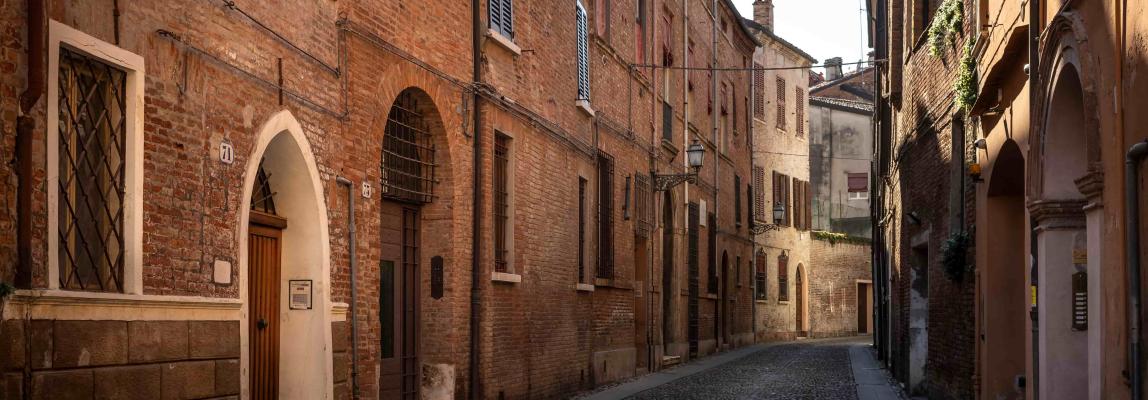
Ferrara's Jewish community is one of the oldest in Italy. The city retains a substantial material legacy comprising a historic ghetto, four synagogues (one of the oldest active synagogues in Italy), two Jewish cemeteries, and the recently opened (2017) Museum of Italian Judaism and the Shoah (MEIS). Yet, despite these assets, the Jewish dimension of the city is often understated in tourism narratives that foreground its Renaissance heritage and UNESCO designation. Jewish key sites remain visually marginal: the ghetto boundaries nearly invisible, the synagogue complex sealed following earthquake damage, the cemeteries peripheral and under-signposted.
Within JEWELS TOUR, Ferrara's ambitions reach beyond the already-known: its priorities include the digitisation of the Jewish community's historical archive to document, share, and communicate local Jewish heritage, the use of AI and big data for heritage access, and the development of slow tourism itineraries for peripheral areas. A ten-episode podcast, Discover Jewish Ferrara, narrated by multiple voices from across the city's Jewish heritage ecosystem, exemplifies the storytelling approach the project advocates.
This dual focus on the digital and the peripheral captures something important about what sustainable valorisation might look like: not just making existing narratives more visible online, but using digital tools to surface stories that have never entered the mainstream narrative at all.
Lviv
Lviv was home to one of the largest and most vibrant Jewish communities in pre-war Central Europe. The Holocaust effectively erased that community, and decades of Soviet rule subsequently suppressed much of what remained of Jewish memory in the public space. Of what remained of the city's many synagogues and Jewish community buildings, most were destroyed during the recent war.
In this project, Lviv focuses on the coexistence of different narratives to strengthen the city image of a multicultural meeting point. The development of multicultural narratives reflects the particular complexity of this context. Telling hidden stories here involves not only accessibility and digital innovation but also confronting a deeply contested past and negotiating whose account of that past is acknowledged and legitimised. An example of this is the current RE:FRAME LILIEN poster competition open to young artists and designers, to reimagine the artistic heritage of Ephraim Moses Lilien, a prominent Jewish illustrator who reinterpreted traditional Jewish motifs as universal metaphors for national resilience.
Lublin
Lublin's Jewish history is one of the richest in Central Europe. From the fourteenth century onwards, the city became a major centre of Jewish life. Today, Lublin's Jewish community numbers only a few dozen people.
Within the project, Lublin aims at the development of an approach to the valorisation of
Jewish heritage that is based on responsible storytelling, one where storytelling becomes the tool to strengthen connections among heritage, memory, and education by enlarging and strengthening the ecosystem of stakeholders (guides, educators, Jewish institutions, cultural organisations) involved in valorising it. In this respect, the Grodzka Gate – NN Theatre has become an internationally recognised model of how cultural institutions can recover and transmit memory in a participatory, community-based way, for example by cultivating traditions such as Jewish cuisine - most notably the cebularz, the onion bread that has become a symbol of the city's multicultural past.
Riga
Riga's Jewish heritage spans centuries, from the formation of the city's Jewish community in the eighteenth century through to the near-total destruction of that community during the Nazi occupation. Today, Riga's Jewish community numbers over 8,000, the largest in the Baltic states. Riga has one only surviving synagogue, the Museum of the Riga Ghetto and Holocaust in Latvia and the Žanis Lipke Memorial.
Within JEWELS TOUR, Riga has prioritised accessibility and knowledge sharing through stakeholder cooperation, to develop a unified knowledge base to valorise Jewish heritage through a deeper community engagement strengthening the connection between tourist guides and the Jewish community. A unique example of this is the work of Rabbi Elijohu Krumers of the Peitav Shul Synagogue, who guides tours for both tourists and locals including Kosher food tastings to promote understanding of Jewish culture and of the daily functioning of the synagogue.
Responsible storytelling and the digital turn
Across all six cities, two themes recur with particular force: the need for responsible storytelling and the potential of digital technology to support it.
Storytelling, as JEWELS TOUR frames it, is not simply a communication technique, it is an ethical and a political act. Which stories get told, and by whom, in whose voice, and with what degree of critical awareness of the telling itself, determines whose heritage is recognised, whose community is legitimised, and what version of the past is passed on to future generations. The project's emphasis on responsible storytelling reflects an understanding that the hidden stories of Jewish heritage cannot simply be extracted and packaged for tourism consumption. They must be recovered through genuine dialogue with the communities that hold them, told within the physical and social spaces where they are rooted, and offered to audiences with enough context to be understood in their full complexity.
Digital technology is central to this work, but not as a replacement for human engagement. Rather, as Bec and colleagues (2019) have argued in the context of immersive heritage experiences, digital tools can help ‘normalise dissonant memories’ by supplying the context that transforms an unfamiliar or uncomfortable fragment of the past into something that can be understood, questioned and debated. Augmented reality, interactive maps, oral history archives, and AI-driven discovery tools all offer ways to populate heritage narratives with the voices and perspectives that official histories have often excluded. As Harrison, Rose, and Sterling (2024) note these technologies open up new possibilities for reinterpretation and renegotiation of the past in public space - shifting the question of heritage from a fixed inheritance to a living legacy whose meaning is always, in part, still being made.
A model worth considering
JEWELS TOUR is, in one sense, a project about Jewish heritage. But in a deeper sense it is a project about how Europe might learn to hold its most difficult histories. Not by smoothing them into comfortable narratives of memory and reconciliation, but by creating the conditions under which hidden, contested, and underrepresented stories can surface and enter into genuine dialogue with dominant ones.
The six cities gathered in this project represent an extraordinary cross-section of that difficulty: from the medieval Sephardic legacy of Coimbra to the devastated Ashkenazi communities of Lublin and Lviv; from the UNESCO-listed monuments of Erfurt to the slow tourism peripheries of Ferrara; from the recovering institutional landscape of Riga to the wartime pressures of Lviv. What they share is not a common heritage, exactly, but a common challenge, and a commitment to meeting it not with expert-led heritage management alone, but with the broader, messier, more equitable engagement that responsible valorisation demands.
If that commitment holds, JEWELS TOUR may yet offer something more than a model for Jewish heritage tourism. It may offer a direction for how cultural heritage, thoughtfully valorised, can contribute to the kind of Europe that the Faro Convention imagined: one in which heritage is understood not as a possession to be protected, but as a shared resource to be actively, critically and collectively inhabited.
More information
www.interregeurope.eu/jewels-tour
Sources
- Bec, A., Moyle, B., Timms, K., Schaffer, V., Skavronskaya, L., & Little, C. (2019). Management of immersive heritage tourism experiences: A conceptual model. Tourism Management, 72, 117-120.
- Harrison, R., Rose, A., & Sterling, C. (2024). Ghosts of solid air: contested heritage and augmented reality in public space. International Journal of Heritage Studies, 31(4), 425-443. https://doi.org/10.1080/13527258.2024.2437367
- Rinallo, D. (2020). Heritage storytelling, community empowerment and sustainable development. Правоведение [Pravovedeniye], 64(1), 57-67.