Healthy placemaking - More than just a buzzword?
11/18/2025 - 16:32
Rather than focusing on aesthetics or adding green spaces - healthy placemaking argues for deliberate strategies to create environments that foster positive health. This extends beyond the mere absence of illness, as it also incorporates helping people feel in control, adapt to challenges, and form meaningful connections.
Hart van Zuid, Rotterdam, is putting this concept into practice with several interventions; to see to what extent a redesigned urban space can truly empower residents, improve well-being, and strengthen social bonds, or whether healthy placemaking is likely to be yet another buzzword.

- Uncover
This article was written for Uncover magazine - Meaningful Leisure Experiences.
Authors: Iris Kerst is Expertise Network Sustainable Urban Tourism programme manager at ARC Expertise Centre. Ko Koens is professor of New Urban Tourism at Inholland University of Applies Sciences.
What is healthy placemaking?
Healthy placemaking integrates public health principles into urban design, promoting physical activity, mental well-being, and social interaction. It goes beyond aesthetics - walkable streets, green spaces, and accessible public areas foster healthier behaviours, social cohesion, and a sense of belonging.
As Fred London (2020) and others note, these environments support not only physical health but also mental resilience and community connection. This aligns with the positive health model (IPH, 2024), which includes six dimensions: physical health, mental well-being, social participation, meaningfulness, quality of life, and daily functioning. Achieving this requires collaboration between planners, communities, and a broader network of local stakeholders often overlooked in traditional planning processes.
Hart van Zuid: a vision for community and connection
Hart van Zuid, including neighbourhoods like Zuidplein and Carnisse, has seen major redevelopment in recent years - new housing, commercial spaces, and amenities have transformed the area. Yet many long-term residents and newcomers feel disconnected from these changes. The risks of disconnection are social isolation, lower civic engagement, and weakened community ties (Putnam, 2000; Kawachi & Berkman, 2000). Gentrification adds pressure, with rising costs and limited integration of new residents, reducing the vitality of public spaces. Key stakeholders - Rotterdam Ahoy, Sportbedrijf Rotterdam, Winkelcentrum Zuidplein, and Theater Zuidplein - are working together to counter this. Their goal is to rebuild pride and belonging through inclusive, community-driven initiatives.
Healthy placemaking in practice
The Foundation Zie Hart van Zuid reached out to the Expertise Network Sustainable Urban Tourism to explore the potential of healthy placemaking in Hart van Zuid. Using a mixed-method research and design approach, they aim to understand how urban design can contribute to health and well-being.
In the first phase, initial research, using a variety of existing data sources (e.g. municipal annual resident surveys), assessed resident sentiments with a view to appreciating how the local environment has influenced the six dimensions of positive health. While some improvements were noted, significant challenges remain, particularly in social participation and meaningfulness. These findings indicate that more work is needed to foster a sense of belonging, engagement, and purpose among residents.
To address these issues, the consortium collaborated with artists and local residents to implement three key interventions: Mi Lobi Zuid, The Hopscotch, and Host Your Neighbourhood.
Mi Lobi Zuid
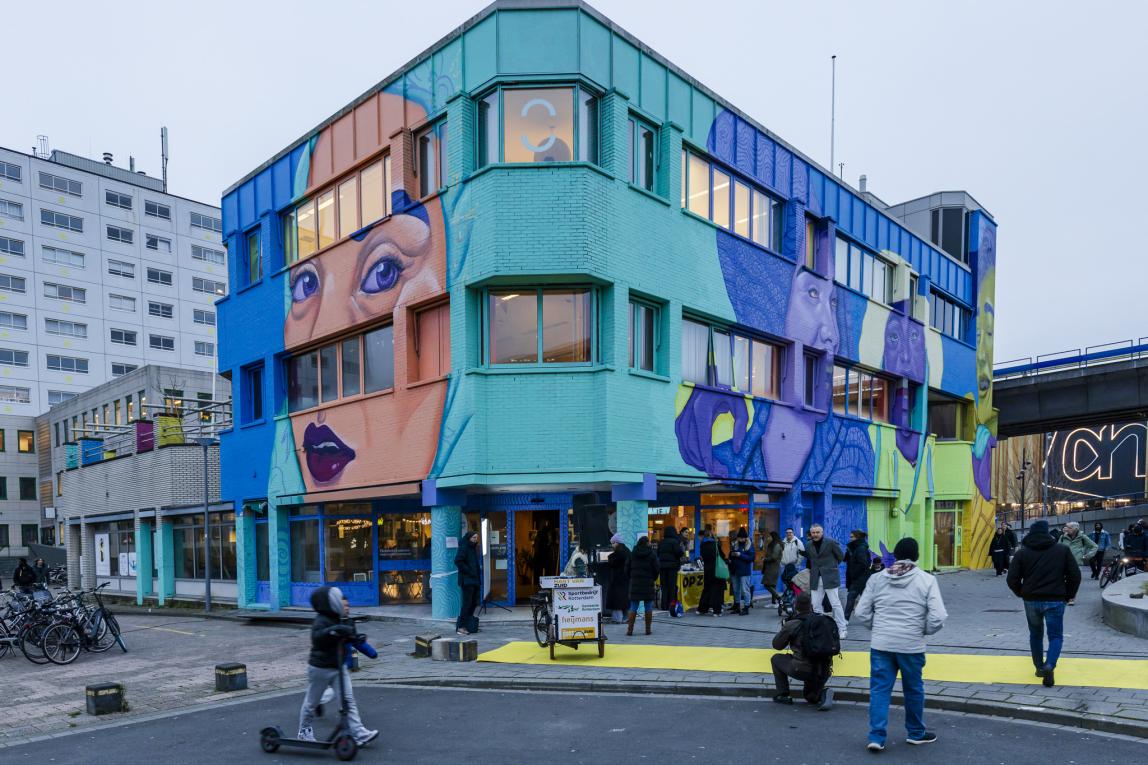
Mi Lobi Zuid (Surinamese for "I love Zuid") was the first intervention designed to explore how creative placemaking could foster a sense of belonging in Hart van Zuid. This initiative used street art to transform the former ABN AMRO building near Zuidplein into a collaborative mural involving 377 residents, students, and passers-by. Led by artist Naomi King, the project was inspired by Inholland graduate Joris Sauerbier’s research on safety perceptions, which suggested that adding colour to public spaces could improve security and well-being.
Beyond its visual impact, Mi Lobi Zuid created an opportunity for participation. The collaborative painting process allowed people to connect, share experiences, and develop a stronger attachment to their neighbourhood. It helped generate positive media attention for the area and was celebrated by the mayor in a video message and during one of her working visits. Researchers gathered insights into how residents envision future interventions, highlighting the need for inclusivity, personal connections, and ongoing engagement.
The Hopscotch
Building on these lessons, The Hopscotch was introduced to encourage physical activity and social engagement. Unlike traditional hopscotch, it features words reflecting Hart van Zuid and its surrounding neighbourhoods, prompting discussions about local identity. Placed on a temporary vacant lot, it transforms an in-between space into a reason to pause, interact, and reflect. The final changes in the design are currently being made, as the original design had to be amended at the last minute due to concerns that it would harm traffic safety.
Host Your Neighbourhood
Host Your Neighbourhood connects residents and visitors through guided tours during major events in Hart van Zuid such as conferences at Rotterdam Ahoy. More than a tourism initiative, it focuses on stimulating community participation and local pride. Volunteers from different neighbourhoods share their perspectives, strengthening social cohesion and belonging. By collaborating with local businesses and institutions, they can help empower residents by providing them with new skills and opportunities to actively engage with their community. However, finding local volunteers is not proving to be easy, as residents are very busy and can be unsure whether the neighbourhood offers plenty to explore and discover or whether they have the skills to guide visitors.
Healthy placemaking: a lasting impact?
The experiences in Hart van Zuid suggest that healthy placemaking must go beyond surface-level design changes. While well-planned public spaces can encourage positive behaviours, the true measure of success lies in how deeply residents connect with their environment. Creating inviting, accessible places is only the first step; lasting change happens when people feel a sense of ownership and agency over their surroundings. Projects like Mi Lobi Zuid, The Hopscotch, and Host Your Neighbourhood demonstrate that engagement and participation are just as crucial as physical infrastructure. These initiatives worked not only because they altered the built environment but because they actively involved the community in shaping those changes.
However, for healthy placemaking to be truly meaningful, it must move beyond temporary interventions and top-down planning. Long-term impact requires an ongoing process in which residents and local businesses take the lead in shaping their own neighbourhoods and are supported by the municipality and other top-down stakeholders. When communities have a say in their environment, this can help strengthen social cohesion, and a shared sense of purpose (Hernandez-Santin et al., 2020).
That this is not easy is exemplified by The Hopscotch experiment where despite continuous efforts to engage with higher level policymakers who supported the intervention, last-minute amendments were still needed. The challenge remains: how can the right conditions for this bottom-up approach be created in a system that is focused on top-down control?
Together with the consortium, ways are being explored to further shift initiative and ownership to residents and entrepreneurs. The key question now is: how can we make the principle of designing with instead of for communities a common rule?
In conclusion, our project findings suggest healthy placemaking has the potential to transform urban environments by fostering well-being, social cohesion, and empowerment. Hart van Zuid serves as a living laboratory for these ideas, showing that intentional, participatory design - coupled with meaningful leisure opportunities - can create more connected, resilient communities.
Sources
- Hernandez-Santin, C., et al. (2020). Regenerative Placemaking: Creating a New Model for Place Development by Bringing Together Regenerative and Placemaking Processes. In R. Roggema (Ed.), Designing Sustainable Cities (pp. 53–68). Springer International Publishing.
- IPH. (2024). Toolkit Positieve Gezondheid op de Tekentafel. Institute for Positive Health. - Kawachi, I., & Berkman, L. (2000). Social cohesion, social capital, and health. Social Epidemiology, 174(7), 290–319.
- London, F. (2020). Healthy Place Making. Wellbeing through urban design (1st ed.). RIBA Publishing.
- Putnam, R. D. (2000). Bowling Alone: America’s Declining Social Capital: Originally published in Journal of Democracy 6 (1), 1995. In L. Crothers & C. Lockhart (Eds.), Culture and Politics (pp. 223–234). Palgrave Macmillan US.