How and why a Breda collective and BUas students turned AI’s inner life into immersive art
08/25/2026 - 15:16

- Uncover
Authors: Marisa de Brito and Licia Calvi are lecturers and researchers at BUas. Marisa specialises in creative placemaking, cultural heritage, engagement, memory and resilience; Licia in digital storytelling and heritage studies, with a particular focus on museum studies and creative placemaking.
This immersive installation by Studio KASBOEK, created with Breda University of Applied Sciences (BUas), poses a deceptively simple question: when a machine reads your gaze and generates meaning, whose perception is really at work? It is a question that resonates at every scale: in a studio in Breda, across a European university alliance, and in the broadest conversation humanity is having about intelligence, culture and what it means to be human.
A collective born from shared notebooks
Studio KASBOEK is a trio of Breda-based interdisciplinary artists – Cathalijne Postma, Debbie van Berkel and Jojanneke Postma – who have worked together since 2008. The name carries the origin story: three artists from different art academies who began mailing each other kasboek notebooks – ledgers of ideas, sketches and half-formed thoughts – and dedicating a fixed weekly day to bringing them to life. From that ritual, a studio was born.
Their practice operates in liminal space: the threshold where the physical and the digital blur, perception is never quite fixed, and the viewer shifts from observer to participant. Working with light, colour and movement, the studio has developed a conceptual framework – R.E.T.I.N.A. (Reality, Evolving, Technological, Inner, Neural, Adaptation) – that guides their exploration of how technology shapes the way we interpret the world.
Latent Space is the latest expression of that framework: a project in which AI functions not as a tool for producing answers, but as a reflective system that gains meaning through interaction with the viewer. The installation adapts in real time to human presence, making every encounter unique – and, deliberately, unpredictable.
The invisible made perceptible
The concept at the heart of the project is borrowed from machine learning: latent space, the invisible multidimensional structure within an AI model where concepts and relationships are encoded – not as words, but as abstract patterns of connection. When an AI processes the word ‘dog’, it does not retrieve a definition; it activates a web of associations: bone, bark, loyalty, mammal, pet. The system thinks, in a sense, without language.
Studio KASBOEK became fascinated by what this means for human experience. Early AI systems moved linearly – input in, output out. More recent models loop back, reconsider and self-correct: less marble run, more snooker table, every angle weighed before the shot is played. This shift is not merely technical – it is philosophical. How do we trust – and evaluate – a system whose process remains invisible?
Latent Space sets out to make that invisible process perceptible – not through data visualisation or scientific explanation, but through art: the language of sensation and open interpretation. It fits naturally within Breda’s ambitions as a City of Creative Talent, with art and technology at the centre of its cultural strategy for 2025–2040.
“We wanted to create an experience that sparks curiosity about AI’s role in our lives, prompting us to consider how machines might ‘see’ us and what that reveals about ourselves – and the nature of understanding itself.” - KASBOEK Collective
A European connection: art, heritage and creative potential
Studio KASBOEK is an Associated Partner of KreativEU, a European alliance that places the creative potential embedded in Europe’s cultural heritage at the centre of teaching, research and knowledge exchange, exploring ecocultural identities and the relationship between communities and their heritage.
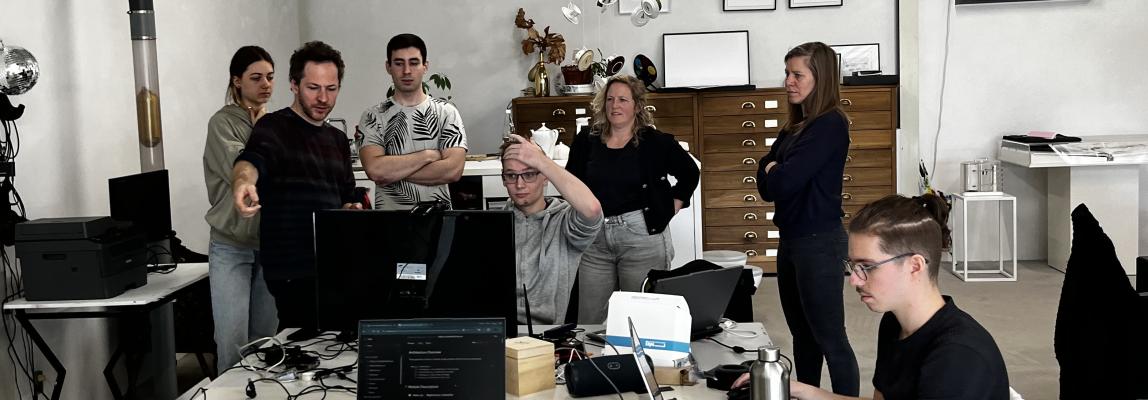
The Latent Space collaboration sits squarely within that mission. BUas students from Applied Data Science & Artificial Intelligence worked directly alongside the artists, contributing to real-time data analysis, sensor integration and the ethical dimensions of the AI systems involved.
For the Places & Flows research unit at BUas, this embodied something central to both the institute’s educational philosophy and KreativEU’s broader approach: students placed inside a live research process, navigating questions with no predetermined answers – about how AI interprets abstract input, and what ethical responsibility looks like when a machine generates meaning in real time.
As an Associated Partner, Studio KASBOEK brought the KreativEU alliance something distinctive: a model of arts practice that treats AI not as a shortcut or content generator, but as a subject for serious artistic and ethical scrutiny. In a European context shaped by the EU AI Act and growing debate about algorithmic governance, that critical artistic voice has genuine relevance.
A universal question: who is perceiving whom?
Cultural heritage has always been shaped by its tools: from oral tradition to manuscript, photograph to digital archive. AI represents a qualitatively different kind of cultural actor – one that accumulates associations, generates interpretations and, in systems like those explored in Latent Space, begins to reflect on its own outputs.
The algorithms shaping what we see online, the recommendation systems curating our cultural consumption, the generative models producing images and text now circulating widely: these are already part of the cultural fabric that will be passed on. The question Latent Space forces to the surface is whether that inheritance is one we are making consciously – or one that is simply happening to us.
Human perception has always been mediated: by language, by culture, by the technologies of a given era. AI introduces a mediator whose inner logic remains opaque even to its creators. Studio KASBOEK’s instinct is that art – with its capacity for ambiguity and its invitation to experience rather than explain – may be better equipped than any other discipline to hold that complexity up to examination.
“For us as artists, it is essential to open up these systems, make them visible and show how meaning is constructed, and to invite a more critical awareness. The question is not only what we create, but what kind of conditions for seeing we leave behind.” - KASBOEK Collective
An open question, not a conclusion
Latent Space – combining eye-tracking, reflection, sound and real-time AI response – has now been presented to audiences. Each encounter is different, shaped by the presence and movement of whoever is in the room.
The project does not resolve the questions it raises about perception, trust and the cultural role of artificial intelligence. It makes them inhabitable – modelling something art has always known: that the most important questions are not the ones with answers, but the ones that keep generating new ways of looking.
Special thanks
The authors wish to thank the Places & Flows research theme of BUas for hosting and facilitating this collaboration, Studio KASBOEK for sharing their artistic process, and students Bence Papp, Vince Németh, Cristina Jadanov, Benedek Vass, supervised by Bram Heijligers, Data Science lecturer at BUas. The project was made possible with the support of Gemeente Breda, Mondriaan Fonds and Brabant C.
Photography
Kasboek