MBA Imagineering: present and future directions
11/19/2025 - 15:12

- Uncover
This article was written for Uncover magazine - Meaningful Leisure Experiences.
Authors: Margo Rooijackers, Nicoline de Heus, Anneloes Henskens, Stifani Herpich, and Wesley Put are lecturers and researchers at MBA Imagineering, Breda University of Applied Sciences.
Stakeholders as co-designers
The world we live in is often described as a VUCA environment - Volatile, Uncertain, Complex, and Ambiguous - presenting significant challenges such as climate change, technological advancements, shifting population patterns, and social issues like equality and inclusion. Addressing these challenges requires innovative approaches to thinking and acting. This includes fostering innovation at all levels - within business and organisational contexts, communities, and even across entire social systems. Linear methods of managing change often fall short. Instead, there is a growing need for skilled professionals who cannot only respond to complex challenges but also build organisational resilience and foster creativity to shape the future of organisations, communities, and society as a whole. The MBA Imagineering programme fully aligns with the BUas vision and mission to educate professionals ‘for and in a continuously changing world’. Based on the Imagineering strategic design approach, it enables students to intervene in organisational and social systems and become effective system innovators. By involving a wide range of internal and external stakeholders, transformation processes have been ignited extending beyond traditional organisational boundaries. In essence, it is an iterative process, grounded in three core activities of design thinking, namely Inspiration (discovering the generative core), Ideation (designing for behavioural change) and Implementation (enabling the co-creation of value) (Nijs, 2019). This holistic approach aims to ensure that innovation is not just a top-down directive, but a collective and co-creative effort involving all stakeholders as co-designers of the future.
Innovation Circle with alumni
The MBA Imagineering was innovative and distinctive in its time. However, over the last two decades, numerous change and innovation programmes have emerged, making it more challenging to pinpoint the exact uniqueness of the MBA Imagineering programme. To address this, the Master Imagineering team hosted the Innovation Circle event in January 2024. This event was attended by over 20 alumni, Dutch as well as international ones, representing student cohorts ranging from 2008 to 2022.
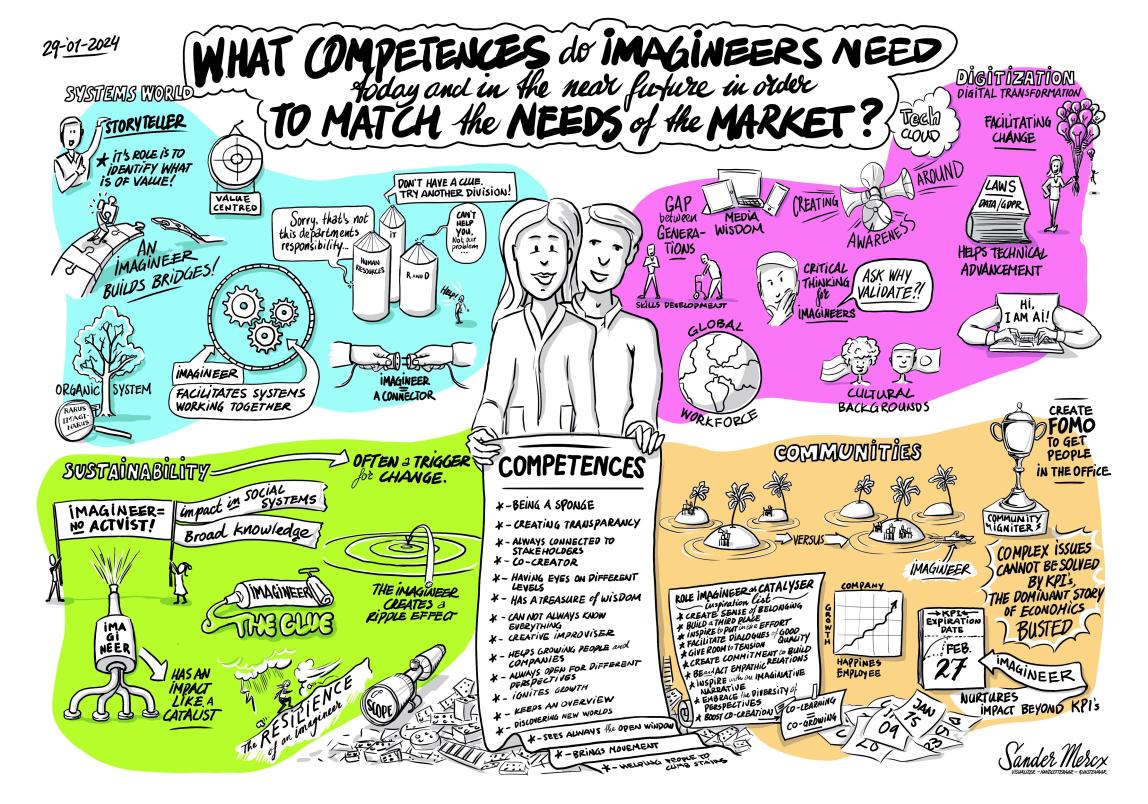
The central question of the gathering was: ‘What competencies do Imagineers need, today and in the near future, to match the needs of the market?’ This question was addressed via a World Café session at four tables, followed by a LEGO® SERIOUS PLAY® workshop. The outcomes provided valuable insights into how alumni reflect on their study experiences and how these shaped them into the innovation professionals they are today. These results illustrate the strength and value of the MBA Imagineering programme, clearly identifying the key competencies to be cherished in the programme's future profile.
In this contribution, the results of the event are visualised through artist impressions and written explanations related to four consecutive topics: (1) Networks & Communities, (2) Sustainability, (3) Systems World and (4) Digitisation. We conclude by synthesising these outcomes through a visualisation of ‘metaphors connected to the Imagineering Professional’, which underscores the unique aspects of the IMA programme compared to other change and innovation master’s programmes.
Outcomes: Networks & Communities
Imagineers recognise the crucial role of learning communities and stakeholder networks in tackling complex issues. However, they often encounter obstacles such as time constraints, financial limitations, and human behaviour that impede commitment. Alumni shared that in their professional practice they face various challenges and discussed five of them in detail. Firstly, the lack of senior support was addressed. Bottom-up efforts to create valuable communities often lack senior-level support due to a focus on KPIs and profit. While collaborative cultures enhance problem-solving skills, their impact is not immediately reflected in KPIs. Imagineers must articulate and visualise the benefits of engaged communities. Secondly, remote work comfort was mentioned as an issue. Employees are comfortable working remotely, making it difficult to build physical communities. For example, attempts to create a learning community around AI faced resistance when physical meetings were required. Another point put to the fore was labelled as ‘fake’ communities. This label referred to commercial-oriented communities, created by organisations, lacking genuine engagement. Lastly, human behaviour was discussed. Many people simply resist change and prefer to associate with similar individuals, making diverse community building challenging.
Takeaways regarding the key competencies of an Imagineer:
- Articulating value: be able to demonstrate the value and impact of nurturing co-creative communities beyond short-term KPIs, emphasising the importance of relationship-oriented goals.
- Self-organisation: act as a catalyst to ignite community participation. Designing inspiring physical gatherings can create a fear of missing out and encourage involvement.
- Diverse perspectives: building communities with diverse perspectives enriches learning and addresses complex issues. This requires effort, commitment, and the ability to facilitate high-quality dialogues, including difficult conversations. Empathy is a crucial competency in understanding stakeholders' psychological and social contexts.
Outcomes: Sustainability
The notion of an ‘Imagineering Centre for Sustainability’ was explored. This centre could serve as a pivotal hub where Imagineers collaborate with practitioners and organisations in transition on sustainability research and development initiatives. At the same time, this concept raised important questions, for instance ‘what does sustainability entail for Imagineers in terms of knowledge and action?’, and ‘should Imagineers position themselves as experts or remain impartial facilitators of dialogue, guiding stakeholders in any chosen direction?’
For Imagineers, embracing sustainability means adopting a mindset geared towards long-term thinking, consistently considering the lasting effects of innovations and changes within organisations. This mindset presents an ongoing challenge. Rather than merely possessing knowledge, Imagineers prioritise continuous learning. They are inherently motivated professionals and forward-thinkers who readily embrace change. Yet, when interacting with organisations, resistance is often encountered and the impact realised is limited, particularly in endeavours related to global challenges.
One vital competency Imagineers must hone is behavioural design, closely intertwined with their existing linguistic and narrative approaches. This involves enhancing their ability to influence and shape new social systems, employing language and narratives to reframe perspectives and provoke critical thinking, thereby fostering mindset shifts - a cornerstone of the Imagineering ethos, also known as Designing for Emergence.
Additionally, Imagineers must cultivate a business-savvy, entrepreneurial mindset concerning sustainability challenges faced by companies, supporting them in transitioning while emphasising value co-creation and economic growth. Social entrepreneurship and sustainable business models emerge as central pillars of Imagineers' entrepreneurial endeavours, making them experts in fostering resilience through Strategic Design.
The debate persisted on the positioning of Imagineers in relation to sustainability, particularly regarding climate change. While recognising its significance, diverse perspectives and priorities among Imagineers worldwide necessitate self-awareness regarding personal biases and cultural backgrounds. Whether adopting an activist stance or a pragmatic approach, professional Imagineers focus on fostering collective understanding while remaining culturally sensitive and striving for neutrality in mediation.
Takeaways regarding the key competencies of an Imagineer:
- A profound comprehension of human and systemic behaviour, coupled with expertise in influencing mindset shifts through linguistic, narrative, and behavioural design.
- Mastery in fostering resilient entrepreneurship to guide organisations through transitions.
- Forward-thinking with a keen sensitivity to intercultural nuances.
Outcomes: Systems World
The concept of transitioning ‘from a systems world to a more human-centred world’ was explored. Over the past years, organisations and society have increasingly built systems for greater efficiency, leading to fragmentation. Given the complex challenges we face today, remaining organised in this fragmented manner is counterproductive. Imagineers refer to this as systems thinking. To address these complex problems, Imagineering professionals must re-establish the human connection across these systems.
The dialogues among alumni evoked strong emotions. Some expressed concerns, such as: “Please don’t put humans at the centre again.” This sentiment reflects the belief that focusing solely on human benefits has led to numerous problems. Instead, we need to recognise that we are part of a larger, interconnected organic system.
In exploring the role and competencies of an Imagineer, the role of the ‘storyteller’ emerged as particularly significant. Imagineers should engage freely with individuals across different silos and departments within organisations, as well as with internal and external stakeholders. By highlighting positive similarities rather than differences, Imagineering professionals can help people from various silos understand shared purposes and foster meaningful connections.
Takeaways regarding the key competencies of an Imagineer:
- Building bridges between systems (and silos).
- Empathy for all people involved.
- Being the ‘glue’ that facilitates connections.
- Acting as the storyteller.
Outcomes: Digital Transformation
In recent years, the world has undergone significant digitalisation. We use social media daily, and almost everyone has experimented with AI at work or school. Nowadays, much organisational change is driven by technology and its advanced applications. Many market disruptors are fuelled by technological innovation. Due to these rapid developments, organisations must develop new business models to survive.
What does this mean for the work of Imagineers? How do we navigate the complexities of working with various technologies? Imagineers must learn to use digital tools to facilitate processes effectively. However, ethical considerations surrounding technology must not be overlooked. Implementing new technologies ethically is a delicate process that requires careful facilitation within organisations. It is crucial to maintain the human touch and ensure that digital advancements complement, rather than overshadow, human interactions. Both aspects must go hand in hand.
AI represents the ability of computers or robots to perform tasks typically associated with intelligent beings, even though it may not yet fully replicate human cognitive abilities. Human beings are still essential for interpreting the information generated by AI, and society needs critical thinkers to ensure this information is understood correctly. Misuse of these tools can have significant consequences. Imagineers play a vital role in adding a human perspective when working with technology and digital tools. Effective use of technology can help maintain connections with people and build sustainable communities of peers. Imagineers can play a crucial role in fostering the development of these sustainable communities.
Takeaways regarding the key competencies of an Imagineer:
- Using technology effectively.
- Adopting an ethical approach to technological transformation, including AI.
Outcomes: Metaphors Connected to the Imagineering Professional
Overall, it was fascinating to observe the diverse metaphors alumni use to describe their roles as Imagineers in professional contexts. These metaphors range from ‘bridge builder’, ‘connector’ and ‘fertiliser’ to ‘disruptor’, ‘change-maker’ and ‘storyteller’. “As an Imagineer I see myself as a fusion cook. In a sense, you function as an organisational therapist. You are bold and brave enough to set the stage for conversations that are needed and to design the right interventions. You know yourself and your strengths. And you know what you are not, which you subsequently need to organise around you”. Alumni see themselves as catalysts for change, which requires a specific subset of Imagineering leadership competencies ranging from ‘nurturing collaborative communities and networks’, ‘facilitating dialogues of good quality’ to ‘creating a sense of belonging’. And from ‘boosting of collective creativity’ to ‘embracing diversity and inclusion’.
These rich metaphors are insightful and clearly demonstrate that the Imagineering master's programme is not a traditional MBA but has its own unique focus. It is precisely this focus that we aim to preserve and cherish in our educational innovation journey. At Breda University of Applied Sciences, and specifically within the MBA Imagineering programme, our goal is to educate the visionary, creative, and innovative professionals of the future.
Sources
- Nijs, D. (2019). Advanced Imagineering: Designing Innovation as Collective Creation. Edward Elgar Publishing.
- Rooijackers, M. (2024). Report of Innovation Circle Event with Master Imagineering Alumni, 29 January 2024. Breda University of Applied Sciences, internal report.