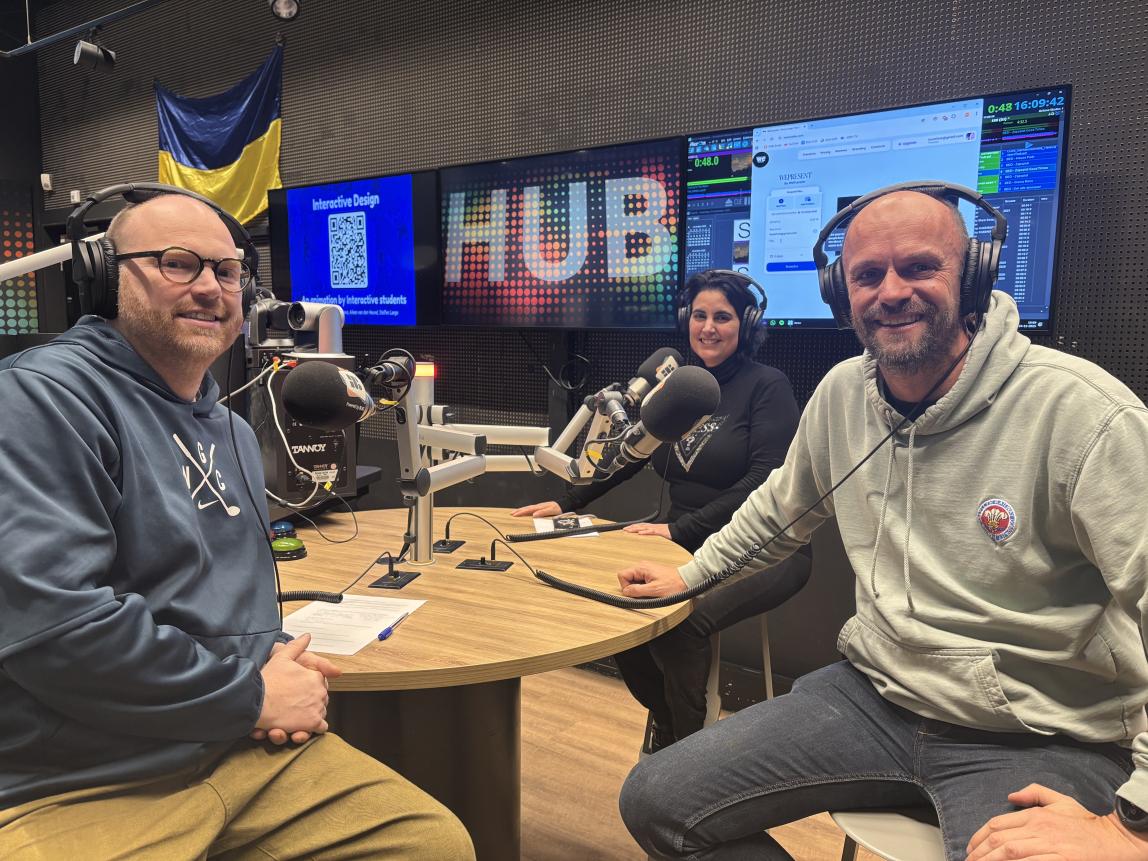
Our second podcast on KreativEU
01/15/2026 - 11:36

- Education
- Expertise
- Industry
Marisa de Brito from BUas’ KreativEU team looks at how street murals bring together university research, local communities and city development. Her talk with professor Jörn Fricke and Dennis Elbers, founder of Breda’s Blind Walls Gallery, shows that heritage isn’t something fixed and decided from above – instead, it’s something that keeps changing and is shaped by everyone together.
Cultural heritage includes both tangible elements like buildings and intangible things like art, music and storytelling, explains Jörn Fricke, who is researching Leisure in a Social Context at BUas. ‘Heritage is not fixed or decided by one person,’ he emphasises. ‘It is something that we all carry, and we must ensure that it benefits us all.’
Since 2014, Blind Walls Gallery has painted nearly 200 murals throughout Breda. Founder Dennis Elbers describes the concept as ‘the city’s art gallery’, inviting international and local artists to create location-inspired work. ‘We dive into the city archive or interview residents to find stories about the location,’ Dennis explains, ‘which is then transferred into a briefing for the artist.’
Community involvement is central to the process. Residents decide which stories to tell and actively engage with the creative process. ‘Because they have been involved from the beginning, people know what’s going to happen,’ says Dennis. ‘So they start to interact with the artist, bring food and drinks, this creates a bond.’
The impact extends beyond aesthetics. In Hoge Vucht, an apartment building in a neighbourhood that was once known as ‘the suicide block’ gained a new identity through a mural. ‘Now we have the most beautiful flat, and nobody will think of that negative connotation anymore,’ residents told Dennis. ‘Now we feel part of the city again.’
Blind Walls is ‘a facilitator or co-creator’ says Dennis. We form a bridge between the worlds of artists, policymakers and local residents, and the different languages they speak. The murals represent a neighbourhood. ‘They become a symbol for a region, just as churches are for cities,’ explains Dennis.
Jörn discovered the murals when he moved from Utrecht to Breda. When he parked at Mols car park, he immediately noticed the urban art surrounding the area. ‘Wow, there’s urban art here,’ he recalls thinking. ‘Once your eyes are sensitised to it, you see it everywhere.’
From a research perspective, Jörn emphasises that policymakers who are unfamiliar with their potential often sideline art-based interventions. He asserts that art plays a powerful and important role in connecting communities to their places, and describes Blind Walls Gallery as ‘one of the most beautiful and powerful examples I know of’.
Partnership between Blind Walls and BUas serves multiple purposes. ‘As a university of applied sciences, we have responsibilities,’ explains Jörn, ‘in the fields of education, research and social impact. By collaborating with organisations such as Blind Walls Gallery, BUas contributes to society, while partners benefit from our knowledge and resources.’
Starting with Blind Walls Gallery proved challenging. It took two years of negotiations before the city council agreed to the Mols parking project, reasoning that the area ‘was going to be gone in three years anyway’. Early success came quickly. ‘I remember the very first brush stroke,’ Dennis recalls, ‘and we had been painting for maybe ten minutes when a lady stopped and said: I really like what you’re doing, I already feel safer here than I did before.’
The focus is now shifting to preservation. With the paintwork expected to last around ten years, choices have to be made: restore, repaint or create a new work of art. Recently, residents dropped by the Blind Walls office unannounced to say that a car park was blocking their view of a mural. ‘They really felt that their space was being invaded,’ says Dennis. ‘That shows how strong the emotional connection is.’
Initially, Blind Walls Gallery was invited to paint in neglected areas that really could use a little bit of love and attention, but now they’re asked to work in newly developed spaces – a phenomenon emerging worldwide in the mural scene. This raises debates about gentrification and how murals affect place perception. However, Dennis views it as an opportunity to tell stories about what existed before the new buildings, creating a sense of place.
Blind Walls deliberately avoids portraying people. ‘It’s like naming a street after someone, I mean, if you show a face on the wall,’ says Dennis. ‘If you don’t see the bigger picture, you can get into trouble later on.’ Instead, they prioritise an ‘artistic translation’, in which ‘the artwork always comes first and the story second’.
Vigilance is required to ensure that diverse voices are heard. Jörn emphasises the role of research in freely acknowledging the political complexity surrounding suppressed histories, citing Black Lives Matter, decolonisation, and the position of women as examples. Dennis once paused a project after sensing incorrect community representation: ‘We went door to door, rang doorbells, explained what we were planning to do and asked people to participate. That gave us a completely different perspective.’
Looking to the future, Dennis hopes that future murals will address sensitive topics such as the city’s role in the slave trade. ‘Murals are an interesting medium for exploring the sensitivity of these subjects,’ he suggests, noting that their work is inspired by the politically charged Latin American mural tradition.
When it comes to discovering local heritage, Dennis advises: ‘Walking, exploring and questioning.’ Jörn recommends slowing down. ‘Choose a mode of transport that slows you down. Or join the walking seminar for KreativEU partners in February!’
The walking seminar for KreativEU partners, in February 2025, will combine tours of the Blind Walls Gallery with the fourth edition of the Blind Walls Film Fest. This five-day festival will present films, lectures and workshops that explore the interconnected cultures of graffiti, street art and muralism.