Romanian Clay Arts as Intangible Cultural Heritage
08/25/2026 - 15:02

- Uncover
Author: Silviu Miloiu is Professor and PhD advisor at Valahia University of Targoviste (VUT) in Romania, institutional coordinator of KreativEU at VUT, and local contact point of the UNESCO UNITWIN Network for Heritage Preservation, Science and Communication for Sustainable Communities.
Seen in this light, Romanian clay arts constitute a form of embodied knowledge. This knowledge is not stored in texts, recipes or diagrams, but in gesture, rhythm and tactile memory. It is transmitted through repetition, correction and shared evaluation, embedded in daily workshop routines and socially regulated ideas of what is fitting and well made. As artisans themselves often remark, working with clay is a negotiation: a sustained conversation with matter shaped by experience and restraint rather than force.
For this reason, pottery offers a particularly lucid example of intangible cultural heritage. What is inherited is not merely the finished object but the entire chain of practice: the preparation of materials, the forming of vessels, the disciplined application of decoration, the management of fire, and the social exchange through which work is recognised and valued. Workshop hierarchies, apprenticeship relations, and local aesthetic vocabularies together form a cultural ecology of making that is continually renewed through practice.
Regional worlds of clay
Horezu is the most internationally renowned centre of Romanian decorative pottery. Its distinction lies in an assured iconography governed by balance and visual discipline. Plates and bowls are organised around a strong compositional centre, with secondary elements carefully distributed so that the surface remains ordered and legible. Decorations are not applied haphazardly, but follow a stable, shared vocabulary whose authority is immediately recognisable.
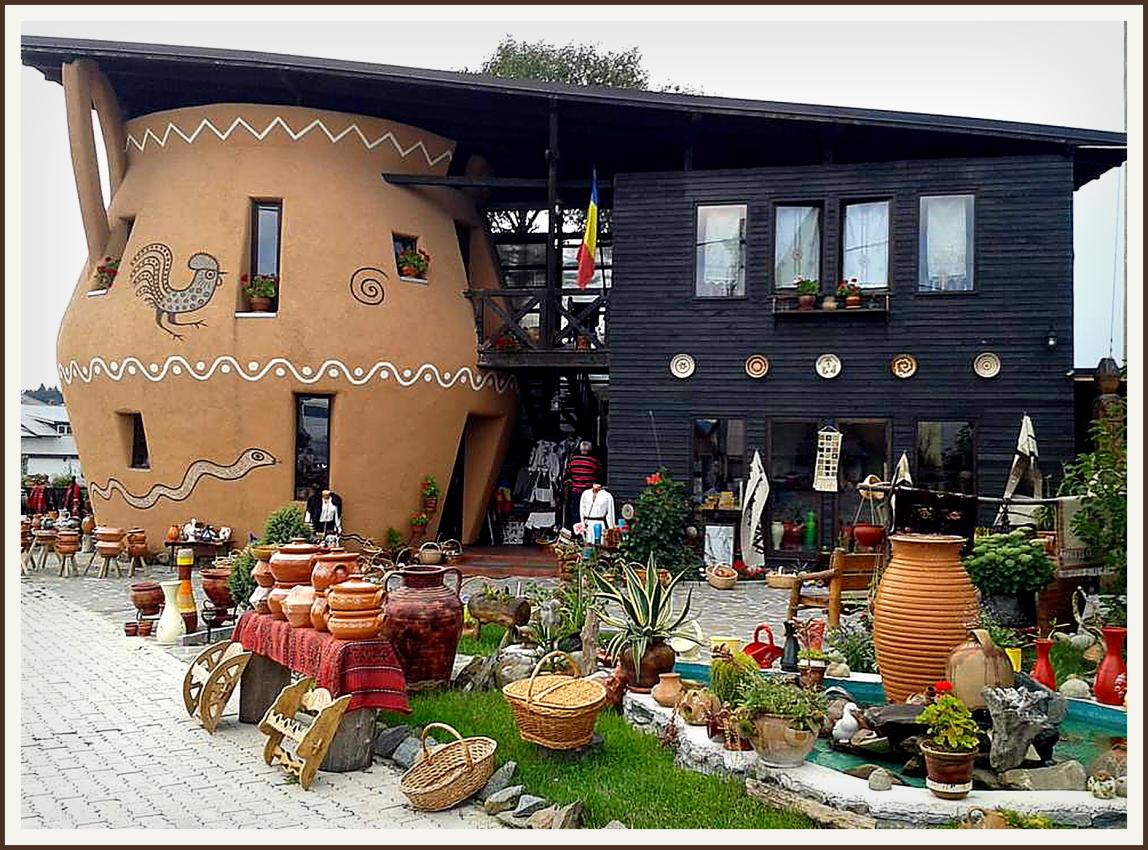
At the heart of Horezu iconography stands the rooster (Cocoșul de Hurez), not simply as an ornament but as a compact moral and temporal symbol. As the herald of daybreak, it signifies vigilance, order and the cyclical measure of rural time. Positioned at the compositional centre, the rooster confers both visual authority and symbolic closure, as though the vessel were signed by the tradition itself. Complementing it, the spiral motif conveys movement and continuity. Often described as the spiral of life, it structures the composition through controlled dynamism, binding fragments of ornament into a coherent whole while evoking the turning of time and the rhythm of seasons.
The colour palette of Horezu pottery is equally intentional. Earthy tones are chosen for their harmony and legibility rather than novelty, reinforcing the impression of deliberation and judgement. Today, such ceramics continue to function as tableware in households attached to traditional aesthetics, as gifts expressing cultural affiliation, and as collected objects valued for their enduring recognisability.
Marginea, by contrast, speaks in the restrained language of black ceramics. Its attraction lies in form, surface and proportion rather than colour. The resulting objects often appear strikingly modern, though their modernity derives from clarity and reduction rather than innovation. With their satin-like surfaces and sculptural silhouettes, Marginea vessels possess an architectural gravity. Decoration, when present, is subtle and textural, never competing with contour. In contemporary contexts, such pieces are favoured for understated interiors, serving ware with presence, and for visitors seeking a distinctly Romanian object free of overt ornament.
Corund represents the exuberant pole of Romania’s pottery. Its painted tradition is festive, generous, and immediately hospitable. Richly decorated surfaces feature floral and zoomorphic motifs arranged with disciplined abundance. Although visually lively, the style is governed by a shared communal grammar that discourages arbitrary invention. This coherence encourages the use of sets and series, where repetition becomes part of the pleasure. Today, Corund pottery thrives as household tableware for gatherings, as souvenirs that retain craft authenticity, and as decorative collections defined by rhythmic consistency.
Beyond these centres stretches a remarkably diverse ceramic landscape. Transylvanian traditions often favour balanced ornamentation and compositional poise, while Moldavian and northern practices display a strong local character in terms of both form and motif. In Banat and western regions, historical influences shape ceramic vocabularies, and in Maramureș, pottery exists in dialogue with wood carving and textile traditions, forming part of a broader material culture rather than standing alone.
Craft, identity and social continuity
Heritage is not merely inherited; it is practised. In Romanian clay arts, continuity is maintained through repetition of studio routines, the training of apprentices, and public evaluation at fairs, markets and exhibitions. Such events act as civic stages where criteria of quality are rehearsed and reaffirmed. They are arenas not only of display but of judgement.
Safeguarding, therefore, must be understood as enabling viability rather than freezing form. Living heritage adapts to new markets, tools and tastes. The essential question is whether change remains guided by communities of practice and whether transmission is robust enough to produce competent makers rather than surface imitation. Pottery, like any skilled craft, tolerates evolution only when it is anchored in mastery.
Contemporary challenges are familiar. Master artisans age, while apprenticeship loses appeal in comparison with more lucrative occupations. Mass-produced imitations distort public perception of skill, and tourism can tempt workshops towards performative speed at the expense of sustained training. While markets may support visibility, they can also erode standards if demand overtakes discipline.
Effective safeguarding begins with recognising craft as knowledge. Documentation alone is insufficient, since recording techniques do not transmit judgement. Research must be paired with opportunities for learning by doing, and promotion must not replace apprenticeship. Education matters most when it creates structured pathways into real workshops, under real conditions, guided by experienced practitioners who uphold demanding standards.
Museums can play a particularly constructive role when they move beyond passive collecting. By inviting artisans to demonstrate processes, teach workshops, advise on interpretation, and engage younger audiences, museums can bridge the divide between heritage as a display and heritage as a practice. In such contexts, collections cease to be static residues and instead become active teaching tools and repositories of technical memory.
Valahia University of Târgoviște and its role in intangible heritage
Within this broader landscape, Valahia University of Târgoviște, as a member of the KreativEU alliance, contributes through its doctoral programmes in history and heritage studies, developed also in the framework of the UNESCO UNITWIN Network for Heritage Preservation, Science and Communication for Sustainable Communities.
Here, intangible cultural heritage is approached as a rigorous field requiring methodological care and ethical responsibility. Partnerships with museum professionals and communities of makers help ensure that research remains grounded in living practice and that safeguarding strategies support genuine transmission rather than symbolic preservation.
Conclusion: earth, fire and the continuity of meaning
Romanian clay arts endure not merely because their objects are admired, but because they embody living systems of knowledge in which material skill, aesthetic judgement and social order converge. As intangible cultural heritage, pottery calls for safeguarding that protects the intelligence of the practice itself – apprenticeship, discipline and shared standards – so that the wheel keeps turning as a serious cultural act rather than a decorative illusion, knowledge patiently shaped in earth and fire.