We Found a Perfect Match in KreativEU
08/25/2026 - 14:46

- Uncover
Author: Maaike Dukker-‘t Hart is Communications Officer and Staff Writer at Breda University of Applied Sciences.
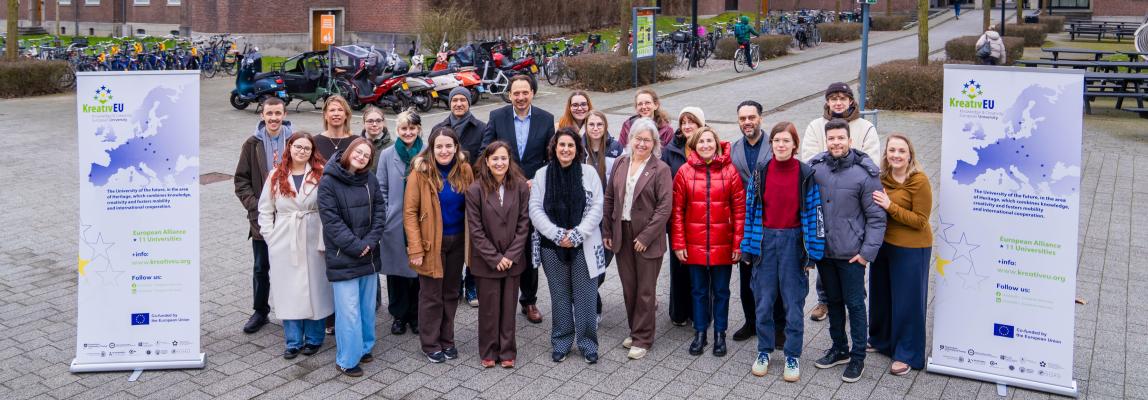
When BUas went looking for European University alliances and partnerships, we found a perfect match in KreativEU – an alliance of European universities of applied sciences united by shared ambitions. This wasn’t simply a board decision; it was, as Jorrit describes it, “a large-scale dating process” to find the right fit. “Joining KreativEU at such an early stage – alongside other driven pioneers – has been something I’m truly glad about.”
Teaming up with 11 universities in Europe, the ultimate goal of KreativEU is to create a European University that puts the creative potential of Europe’s cultural heritage at the heart of its teaching, research and knowledge-sharing activities.
A dynamic and proactive European campus
Looking ahead, Sannie sees short-term goals focused on getting as many students as possible involved in exchanges and European projects. In the medium term, plans include developing joint master’s degrees, micro-credentials – short courses that lead to recognised certification – and expanding research partnerships. The long-term vision? A dynamic, proactive European campus – whether physical or virtual – where people keep learning from each other and remain open to different perspectives and ideas.
KreativEU is all about connection – linking people, disciplines, and regions. In a world that’s becoming more divided, it stands for Europe’s democratic values while fostering innovation and resilience. As Jorrit puts it, “The future lies in Europe, and as a university of applied sciences like ours, we need to play an active role in it.”
Human-Centred and Future-Forward
What makes KreativEU special is the remarkable synergy between its themes and BUas’ research agenda and degree programmes. Creativity, cultural heritage, and sustainability are key, with AI seamlessly integrated across all domains.
“It fits perfectly with our updated strategic direction,” says Jorrit. “Human-Centred and Future-Forward aren’t empty slogans – they reflect what we genuinely stand for. In today’s challenging geopolitical climate, we want our students to face the future with confidence and the skills to navigate it. This includes human skills such as critical thinking, ethical awareness and creative entrepreneurship, but also digital fluency. Being AI-informed matters – and so does knowing when to use it and when not to.”
In the field of AI, BUas is a leader within the KreativEU alliance. You may have already read about this in previous editions of Uncover. BUas leads Work Package 5, focusing on AI and sustainability. “In this context,” says Sannie, “we organise international hackathons where students, researchers and professionals collaborate to connect cultural heritage with sustainability through AI solutions. Recent events in Poland and the Czech Republic have generated innovation ideas like apps bringing historical stories to life and tools helping heritage managers with climate adaptation.”
BUas’ expertise in applied AI, championed by Professor Carlos Santos, is in high demand across the KreativEU alliance – partners frequently call on us for support. But it’s very much a two-way street. While we share our AI knowledge, we gain fresh insights into fields like cultural heritage and archaeology. This genuine cross-pollination speeds up development for everyone and gives our students valuable international experience.
“Future-readiness, then, is the first pillar of our updated strategy. But the whole KreativEU concept also fits in very well with what we at BUas aspire to be,” says Jorrit. “We are establishing ourselves as a leading European university, with a strong focus on applied research that is closely linked to education and society. That is the second key pillar of our strategy. We are strengthening our European presence through strategic partnerships, such as KreativEU.”
A positive and forward-looking perspective
KreativEU unites institutions that share a commitment to delivering top-notch education and recognise the vital role of research and innovation. Most importantly, these universities have a common DNA – a positive, forward-looking, pioneering perspective and a genuine desire to make the world a better place.
“The goal is to collaborate ever more closely – in both education and research – building on what we’ve already achieved together,” says Sannie. “Breda has a rich cultural heritage, and building local connections felt like the natural place to begin. We found a wonderful partner in the city’s Grote Kerk, which has since become an honorary member of the KreativEU network. We also joined forces with the creative team behind Breda Blind Walls, an initiative that uses large-scale murals to bring the cultural heritage of Breda and its surrounding region to wider public attention. Meanwhile, our Storytelling research group is exploring potential collaborations with other cities around the theme of stumbling stones – a memorial to the victims of National Socialism.”
In our partner cities, they do the same: start small, seek collaboration with local and regional businesses, and then broaden the scope to see where we, as KreativEU partners, can find common ground and strengthen one another. “This is something that needs to grow,” says Sannie, “and it starts with us sharing a great deal of our work with one another. Then we can start to see where our interests align. That’s why it’s so wonderful that this anniversary edition of Uncover gives us a platform to showcase some of our partners’ best practices in the field of cultural heritage.”
On the following pages, we’ll take you through various case studies set up across Europe as part of the KreativEU initiative, illustrating the value of intangible cultural heritage. Enjoy reading and let yourself be inspired.
More information
If you have any ideas for further collaboration within the KreativEU framework, please feel free to contact Sannie van Boxtel at [email protected].
The KreativEU alliance activities are co-funded by the European Union (Project No. 101177256, ERASMUS-EDU-2024-EURUNIV). Views expressed in the articles are those of the authors and do not necessarily reflect those of the European Union or the European Education and Culture Executive Agency.