Why investing in street culture and sports pays
11/18/2025 - 09:39

- Uncover
This article was written for Uncover magazine - Meaningful Leisure Experiences.
Author: Peter van der Aalst is a lecturer, researcher and PD candidate at Breda University of Applied Sciences.
The value of street culture and sports
Street culture and sports are catch-all terms. The communities involved are diverse although they have common characteristics such as the strong bottom-up power.
Conducting research into the value that street culture and sports have or may have for both the several communities and the city or municipality as a whole is the core of my Professional Doctorate project. The focus lies on the cities of Breda, Tilburg, and Rotterdam, but insights from observations and expert interviews in other cities inside and outside the Netherlands are also incorporated to provide as complete a picture as possible. In addition, quantitative research is being conducted among players of street sports. The aim - with this knowledge - is to contribute to investments in street culture and sports that are valuable to communities and cities.
Based on a number of initial interviews and focus groups, a reasonably shared view of the social value of street culture and sports is already emerging.
Encouraging creativity and entrepreneurship
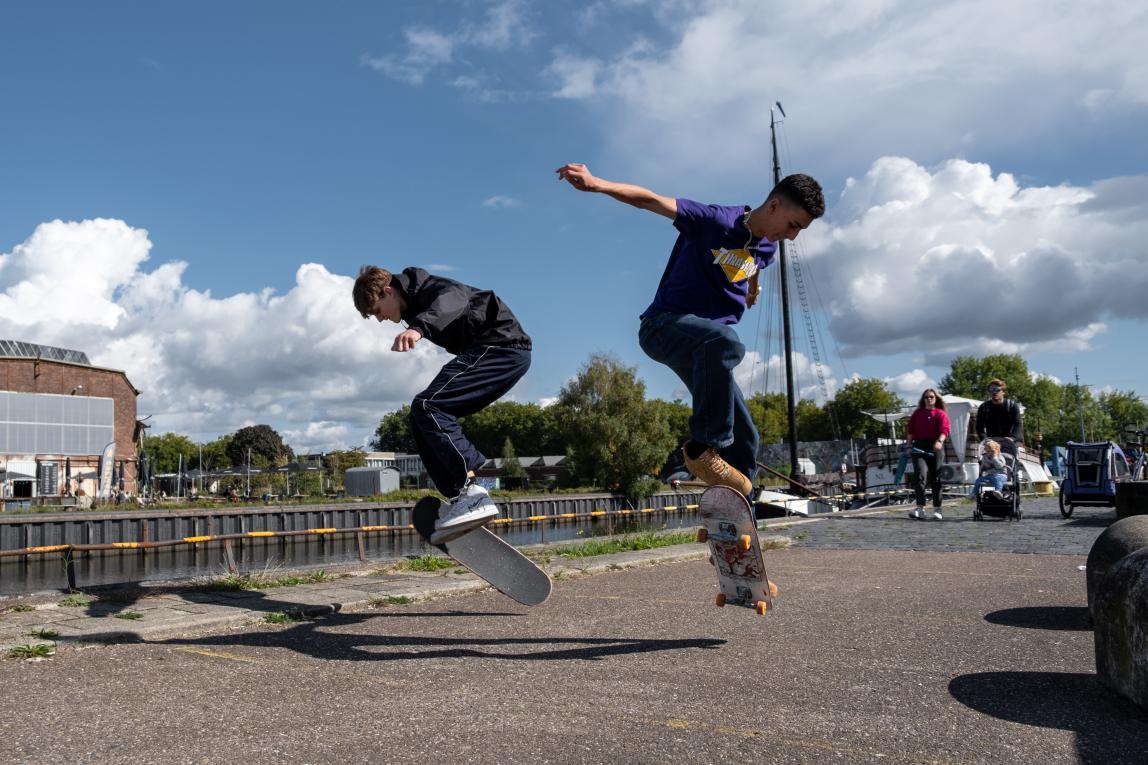
Street culture and sports encourage young people to look at their environment in a different way, which requires a creative approach and a flexible way of thinking. Young people learn to take initiative and set up projects without any fixed structures.
“When you grow up on the streets with your sport and your friends, you have to take a lot of initiatives yourself. You have a certain freedom, you start to see the city in a different way, as a playground. This allows you to use objects and places in ways other than their intended purpose. You learn to look at things in different ways, which fosters a certain creativity that you then carry with you into what you do next”, says Rinse Staal from Pier 15 skatepark. “I think there is plenty of entrepreneurship in that scene and loads of creativity. So, if you create such places where they come together, this may have a flywheel effect on innovation, new ideas, which makes your city more enjoyable”.
Identity formation and self-expression
In many cases, street culture and sports serve as a form of self-expression where young people can explore and shape their own cultural and personal identity. The cultural element is seen as valuable because it helps young people express themselves. This process of self-discovery takes place in various forms, such as hip hop, graffiti, dance and other elements of street culture. It not only offers young people the opportunity to express themselves, but also helps them develop a sense of pride and identity.
Talent development, self-fulfilment and social development
Street culture and sports offer young people the opportunity to explore and further develop their talents. This does not just help them improve their skills, but also gain access to broader (professional) opportunities in society.
“Some more than others, of course, but I see people that are attentive and train with that team and things like that; I see them growing on a personal level too. They are absorbed by that group of people and that community and, in my experience, they go through a kind of accelerated growth process”, says Ruud Lemmen from Hall of Fame in Tilburg.
Diversity, inclusion and accessibility
In a city where different cultures come together, street culture and sport can play an important part in promoting diversity and cultural exchange, by offering a platform where people from different backgrounds come together and learn from each other. This offers young people the opportunity not only to celebrate their own culture, but also to be open to the culture of others, which contributes to a more inclusive society.
Unlike traditional sports clubs and cultural institutions, most street culture and sports facilities are accessible and low-threshold to young people from different social backgrounds. However, physical proximity is also an important factor: “People in Noord in general, regardless of whether they want to skate or whatever, don't go to other parts of the city very often. They do go to Studio Noord or to a youth centre there”, says Ruud Lemmen.
Despite an image of inclusivity, there are surely still challenges in practice. “I find it less open than it should be. It's often the case that communities like that say ‘we're open and anything goes here and things like that’, but you have to belong, you have to get in first", says Ruud Lemmen.
"In my experience, hip hop isn't very inclusive; there's still a patriarchal mindset among many members of that scene. Spoken word is much more inclusive, in my opinion; that's already completely included,” says Teun van Irsel, cultural strategist for the municipality of Tilburg.
Social cohesion and community building
One of the striking aspects of street culture and sports is the way they contribute to social cohesion and community building. In urban environments, young people might sometimes feel they are not being heard or they are excluded from society. Street culture and sports offer a platform where young people, regardless of their background, can connect with others who share the same interests. “I also think that places like Skateland can play a very important role in social cohesion in these neighbourhoods. When we have an event here with the neighbourhood, for the neighbourhood, by the neighbourhood, you do indeed see white, highly educated mothers with three white children among the black children from the neighbourhood and the mothers from the neighbourhood, which is maybe a bit exaggerated, but together... You both have a skateboard with wheels underneath. So that's actually your common denominator, which can create more understanding for each other”, says Frans Dietvorst from Skateland.
The feeling of being part of a community offers young people a safe space to express themselves, and at the same time, it strengthens social bonding within the city. This promotes not only personal development, but also cooperation and solidarity within a community.
At the same time, the way in which young people develop within street culture and sports has changed. According to Danijel Ribaric from Roffa Rotterdam, young people start out individually more and more often, through online content before taking the step to a community. This makes it harder to train new community leaders and maintain the social structures within street culture and sports. Chiara Riboch from Studio Noord agrees: "Because social media is such a big part of our lives, even bigger than the offline world. Everyone takes a bit of everything, so to speak. And... yes, so I think identity formation has changed quite a lot. I don't think it's the same as it used to be".
Knowledge transfer: each one, teach one
There is a natural transfer of know-how between generations. Respect within the scene is not determined by age or status, but by commitment and passion. Generations learn from each other and support each other. “So that knowledge transfer across all those levels - because they're all mixed together into one single heap - works really well. So I think I'd like to mention that about street culture, that mutual respect and the different ages and generations are important”, says Rinse Staal.
Dennis Elbers from Blind Walls Gallery in Breda would like to use his position to transfer knowledge to younger generations: “I would really like us to have three places here for people that do not necessarily cost a lot of money, where I can let them experience what it is like to work here, to develop ideas, and who can also use them to make things for their own target group”.
Physical and mental health and well-being
The physical aspect of street culture and sports contributes to a healthy lifestyle, while the social aspect can play an important role in reducing stress and promoting a sense of belonging. Street sports offer young people an accessible and low-threshold way to be physically active, outside traditional structures. At a time in which obesity and mental health issues among young people are on the rise, it can play an important role in improving their well-being.
The informal nature of street culture and sports makes it appealing for young people to exercise without the competitive pressure that traditional sports entail. Social interaction is also an important factor in health. "So culture, art, sports, but also being there for each other and trying to help each other out. That's what it's all about here, also because we're in a very challenging neighbourhood, the Feyenoord district. It gave me goosebumps when I first started here, seeing mainly kids from the neighbourhood who you know are having a tough time, just enjoying riding their skateboards here", Frans Dietvorst says.
Urban dynamism and area development
The place where Pier 15 is located has transformed from disreputable fringes of society into a vibrant cultural area in ten years’ time. This demonstrates that successful initiatives can redefine public space and contribute to a vibrant and liveable city. Tyrone Tjon-a-loi, culture broker in the city of Den Bosch, who has long been active within the street culture and sports communities of Tilburg, pictures this dynamism: “These are the steps you can actually outline: first, we take the old empty buildings, the ones that also have a bit of charm. These are now almost all filled in every city. Then we move on to the industrial estates with slightly less old buildings, but ones that are really starting to look a bit run down, and then you tackle those”.
Creating these kinds of places, where different groups come together, can make the city more attractive and diverse. Street culture and sport play a role as catalysts for a vibrant and lively city, for dynamism and innovation, and bring creativity and entrepreneurship to the public space. However, municipalities often struggle to facilitate this dynamism because existing structures are often rigid and do not fit well with the bottom-up approach of street culture and sports. "Area development offers many opportunities, but you don’t find the people who understand this side of the story there", says Dennis Elbers. Teun van Irsel from the municipality of Tilburg, however, certainly sees the value of this form of value creation: “Studio Noord as one of our rule-free spaces. And these are the places we want to create in the city, where people can simply walk in with an idea”.
Conclusion and recommendations
Based on the initial research phase, a picture emerges of the social value of street culture and sports, and a number of recommendations can be made.
Street culture and sports encourage creativity, entrepreneurship, identity formation, talent development, social cohesion, inclusion, and health. Their accessibility and bottom-up nature mean that the strength comes from the community itself, not from institutional frameworks. This requires a different kind of involvement from the municipality; as a facilitator, not as a director.
Investments in physical space should preferably be flexible and accessible, with room for self-organisation. It is recommended that ‘rule-free spaces’ should be facilitated; places where young people can experiment and develop themselves, with as few bureaucratic barriers as possible. This requires trust in the community and a willingness to let go of or adapt existing structures. Street culture and sports often fall between different policy areas, resulting in a lack of integrated strategy and fragmented funding.
It is recommended that cities should recognise street culture and sports communities as partners in urban development. The expertise and experience within these networks are valuable for successfully designing places that function socially, creatively and sustainably. Invest not only in bricks and mortar, but first and foremost in people. Make room for their creativity and dynamism in urban policy, and facilitate encounters, ownership and knowledge sharing. To reach a diverse target group, it is important that facilities should be created close to where people live, including in neighbourhoods outside the city centre. This will ensure that street culture and sports truly become a sustainable added value for the city and society.